
This post may contain affiliate links, meaning I receive a small commission if you make a purchase using these links. As an Amazon Associate, I earn from qualifying purchases at no additional cost to you.
Let’s make teaching numbers to 10 fun with exciting games and activities in the classroom! There are so many ways to teach numbers to kids, so add these to your teacher toolbox next time you need them.

Teaching Numbers to 10 in Fun Ways
Numbers to 10 may seem simple, but they are the foundation for so much of the math students will learn later. Before children can confidently add and subtract, work with larger numbers, understand place value, or solve more complex problems, they need a strong understanding of how numbers work and how they relate to one another.
Building this foundation takes more than simply counting to 10. Students need opportunities to practice counting, recognize numerals, connect each number to a specific quantity, and understand that the last number they count tells how many objects are in a group. They also need to develop skills like subitizing, composing and decomposing numbers, and comparing quantities and numerals.
These early number sense skills can take time to develop, and some students may find them frustrating at first. The good news is that learning numbers to 10 can be playful, hands-on, and engaging. The more opportunities children have to explore numbers in meaningful ways, the stronger their foundation for future math learning will become.
In this post, you’ll find strategies and activities to help students build number sense through counting, numeral recognition, one-to-one correspondence, cardinality, subitizing, composing and decomposing numbers, comparing numbers, and assessment. Whether you’re introducing numbers to 10 for the first time or looking for ways to strengthen these skills, these ideas will help you give your students the foundation they need for future math success.
Why Number Sense to 10 Matters
Numbers to 10 are some of the first mathematical ideas children encounter, but they are anything but basic. Developing a strong understanding of these numbers gives students the foundation they need to make sense of more advanced math concepts.
When children understand numbers as quantities, they begin to recognize relationships between numbers instead of simply memorizing number names. They can see that 6 is one more than 5, 8 is two more than 6, and 10 can be made in several different ways. These relationships become important as students move into addition, subtraction, place value, and eventually more complex mathematical thinking.
Number sense also helps students become flexible with numbers. Instead of relying on counting every object or memorizing an answer, they can use what they already know to solve a problem. For example, a student who understands that 5 and 5 make 10 can use that relationship to solve other problems more efficiently.
A strong foundation with numbers to 10 can also make future math learning less frustrating. When students have had plenty of opportunities to count, compare, build, break apart, and represent small numbers, they have a collection of strategies they can draw on as the math becomes more challenging.
For this reason, spending time developing number sense to 10 is not time spent on “easy math.” These early experiences help children build the understanding, flexibility, and confidence they need for everything that comes next.
Essential Number Sense Skills Students Must Master
Developing number sense to 10 involves much more than reciting numbers in order. Students need to understand what numbers represent, how quantities connect to numerals, and how numbers relate to one another. These foundational skills work together to help children develop a flexible understanding of numbers.
Counting
Students need to count in the correct order and use counting to determine how many objects are in a group. Give children plenty of opportunities to count real objects, move or touch each object as they count, and practice counting different types of collections.
Numeral Recognition
Students should be able to recognize and name the numerals 0–10. More importantly, they should understand that each numeral represents a specific quantity. Matching numeral cards with groups of objects, ten frames, fingers, and other representations helps children make these connections.
One-to-One Correspondence
One-to-one correspondence means matching one number word to one object when counting. A child who has mastered this skill can count a group without skipping objects, counting an object more than once, or saying more number words than there are objects. Hands-on counting activities are especially helpful for developing this understanding.
Cardinality
Cardinality is the understanding that the last number said when counting a group tells how many objects are in the group altogether. For example, when a child counts five bears and then answers “5” when asked how many bears there are, they are demonstrating an understanding of cardinality.
Subitizing
Subitizing is the ability to recognize a small quantity without counting each object individually. Children may quickly recognize 3 dots on a card or know that the dots on one side of a die represent 4. Building subitizing skills helps students become more efficient with numbers and lays the groundwork for understanding number combinations.
Composing and Decomposing Numbers
Students need to understand that numbers can be made up of smaller numbers and broken apart in different ways. For example, 5 can be composed as 4 and 1, 3 and 2, or 5 and 0. Counters, linking cubes, fingers, and ten frames give students opportunities to explore these relationships physically.
Comparing Numbers
Children should be able to compare quantities and numerals and understand concepts such as more, less, and equal. Questions like “Which group has more?” or “Which number is greater?” encourage students to think about relationships between numbers rather than simply identify them.
Applying Number Sense
Ultimately, students should be able to use these skills together. They might count a group of objects, identify the matching numeral, explain how they know how many there are, compare the quantity to another group, or show a different way to make the same number. These experiences help children move from simply knowing numbers to actually reasoning with them.
Developmental Progression from Numbers 0–10
Children develop number sense over time, with each new skill building on what came before. While every child develops at a different pace, this general progression can help guide instruction with numbers 0–10.
1. Explore Quantities
Children begin noticing and talking about quantities in everyday experiences. Give them opportunities to explore amounts using objects, fingers, pictures, and other hands-on materials.
2. Develop Counting Skills
Children learn to say numbers in order and connect each number word to an object. They begin developing one-to-one correspondence and understanding that the last number counted tells how many objects are in the group.
3. Connect Quantities to Numerals
Children begin connecting written numerals to the quantities they represent. For example, they learn that the numeral 4 represents a group of four objects.
4. Develop Subitizing Skills
Children begin recognizing small quantities without counting each object. Showing quantities in different arrangements helps them become more flexible in how they recognize numbers.
5. Compose and Decompose Numbers
Children discover that numbers can be made and broken apart in different ways. For example, 5 can be made with 3 and 2 or 4 and 1. Manipulatives and ten frames help children explore these relationships.
6. Compare and Reason About Numbers
Children begin comparing quantities and numerals, using concepts such as more, less, and equal. Encourage students to explain how they know rather than simply identify an answer.
Keep the Progression Flexible
This progression is a guide, not a strict checklist. Students may develop these skills at different rates or need additional practice with certain concepts. Meet students where they are and provide repeated opportunities to explore and build their understanding of numbers 0–10.

Strategies for Building a Strong Foundation
To help students succeed in math, give them a solid foundation. Here are some simple ideas you can incorporate into any classroom setting.
Add in Multi-Sensory Learning
Kinesthetic activities are a great way to get kids moving and learning outside of writing on a worksheet. They have to move and manipulate objects to grasp an idea!
- human number line – invite students to hop on the number line to visualize concepts.
- number songs – add fun songs to your morning meetings or math block to teach number sense
- poems about numbers – use poetry to help kids remember essential math facts
- number formation rhymes – create or use rhymes that students can recite to help when they write numerals
- outdoor number lines – let the kids create number lines in chalk on the playground

Visual Aids & Posters
Displaying visual aids is an excellent way to give kids a reference point while they work on individual tasks. After you teach an idea, put it on the wall or on an anchor chart for students to reference. They will appreciate having reminders throughout the day. These “I Can” posters help guide instruction and remind students of learning outcomes.

Create a free number-of-the-day poster to help kids visualize numbers and practice number concepts. Kids will enjoy taking the time each day to focus on one number. This helps them learn about quantity and build number sense.

Teachers can also implement flashcards. Each Mindful Math unit has mental math cards that are easy to use during whole-group lessons, in math centers, or small groups.

Repetition & Reinforcement
A simple way to build number sense is to stay consistent. Practice a number of the day to get kids used to learning math skills each day. Once you introduce a number, use it throughout the day. Discuss it while waiting in line during a transition, review it at the teacher’s table, and use it in math centers!
Group Activities
Begin your math mini-lessons by teaching students as a group—model how to work on a skill and then send them off to new activities to practice. The practice stations work well when kids practice alone and with partners. Add group or partner games so kids can learn from one another. Collaboration lets them teach and challenge one another.
Lessons & Hands-On Activities & Games for Number Practice
Counting & Matching Numbers to 10
Help kids learn to count to ten forwards and backward! Have them match numerals to corresponding quantities and explore numbers.
Activities
- Provide opportunities to use a number line and chart that puts numbers in order.
- Give sets of numbers to order correctly by finding them on the number line.
- Cover different numbers on a number chart with sticky notes and ask kids for the missing numbers.
- Build Lego stacks by putting the pieces together in an order written on the blocks.
- Count to 10 with a partner, going back and forth from one number to the next.
- Invite kids to color quantities that match a given numeral.
- Draw pictures to represent each number to 10.
- Count and connect cubes to make towers of 10.
- Have kids create number crowns after learning about each number.

Teacher Tip: Make counting and matching numbers a hands-on routine whenever possible. Instead of only asking students to identify a numeral, have them build that quantity with cubes, counters, or other manipulatives and then match it to the numeral. This helps children connect the number they see with the amount it represents.
Writing Numerals to 10
Students should practice number formation by writing each numeral to 10. Explain to kids how to form each number correctly. Try a fun number-formation poem to help them remember how to write each one. Posters, number lines, and calendars are helpful tools.

Activities
- Write numbers on practice pages with pencils or crayons or on whiteboards.
- Complete number puzzles in a group or individually.
- Provide students with numerals to color and copy.
- Form numbers using playdough during math centers.
- Complete a number shape craft as a whole group.
- Invite students to write the number on a whiteboard and draw the corresponding number of dots.
- Form numbers using snap cubes or other blocks.
- Use paint daubers to trace numbers on the page.
- Trace letters in the air during whole-group lessons using fingers.

Differentiate: If students aren’t ready to write numerals independently, give them extra support with tracing cards, dotted-line numbers, or a starting dot that shows where to begin. Students who are ready for a challenge can practice writing numerals without a model and then draw the matching quantity of objects.
One-to-One Correspondence
This concept focuses on counting objects one at a time and in the correct order. Show students how to count by touching each object as they count. Then, show them that objects can be moved away as they count or crossed off.
Activities
- Sort picture cards by matching numerals to quantities.
- Place dots on butterfly wings as kids count. Turn this into a simple craft.
- Fill in ten frames with counters and other manipulatives.
- Form number chains with math links to represent numbers.
- Let kids play a game that involves counting spaces as they pull cards.

Classroom Example: Give each student a small pile of counters and a numeral card. Have them touch and move one counter at a time as they count, saying each number aloud. When they finish, ask, “How many did you count?” This helps students understand that the last number they say tells how many objects are in the group.
Cardinality & Conservation
Counting and conservation are the idea that the final number counted represents the number of objects. During a lesson, a teacher displays a set of objects and has students count them. After counting, ask, “How Many?”
Activities
- Utilize clip cards for counting. Students practice number sense and fine motor skills.
- Complete number puzzles in centers or with partners.
- Let students practice counting aloud with a partner.
- Play the “I have, who has” card game during math block.

Teacher Tip: Change the arrangement of the objects after students count them, then ask, “How many are there now?” For example, spread five counters farther apart and have students recount. Talk about how there are still five counters even though they look different. This helps students understand that the quantity stays the same when the objects are rearranged.
Subitizing
Subitizing involves students looking at a set of dots or objects and quickly stating how many without counting. Show students arrangements of die faces or popsicle sticks. Encourage students not to count when you show the object. Allow them to recreate the number in their own way.
Activities
- Play the “I have, who has” card game in math centers with dot representations on the cards.
- Sort dotted cards that represent numbers. Remind students to quickly call out the number and try not to count.
- Print and complete color-by-number activities in math centers.

- Practice daily subitizing on the board as a whole group before centers.
- Encourage subitizing when students play a board game with dice.
- Give students dominoes and have them subitize the number of dots on each half of the domino.

Teacher Tip: Start with small quantities, such as 1–5, and give students plenty of time to look before responding. Ask, “How did you know?” to encourage students to explain what they noticed, such as seeing two dots and three dots together to recognize five. The goal is to recognize quantities without counting, not simply to answer as quickly as possible.
Estimating with Numbers to 10
To master estimating, students roughly calculate the value, number, or quantity. This involves showing students different sets of scattered objects and letting them guess how many are in the arrangement.
Activities
- Have students guess how many objects are in a partner’s cup during centers.
- Use estimate mats in math centers to get students used to the concept.
- Introduce an estimation worksheet during independent work times.
- Place a jar of manipulatives or objects out for students to make guesses.

Classroom Example: Place a small group of counters on the table and ask, “About how many do you think there are?” Let students share their estimates before counting the objects together. Then compare their guesses to the actual number and talk about whether their estimates were close. Remind students that an estimate is a thoughtful guess, not an exact answer.
Comparing & Ordering Numbers to 10
Students look at two different quantities or numbers and decide which is greater than, less than, or equal. Ask students what greater than, less than, and equal mean, and review the symbols for these concepts.
Activities
- Build and compare cube towers. The taller the tower, the greater the number.
- Use counters to show which numbers are more or less.
- Compare number cards in math centers.
- Complete Mindful Math worksheets to practice comparing and ordering.
- Have students place paper clips on corresponding number cards and compare which have more and which have less.

Differentiate: Let students compare quantities with manipulatives before introducing the greater than, less than, and equal symbols. Students who need extra support can use two groups of counters to decide which has more, less, or the same amount. Once they understand the concepts, introduce the symbols as a way to record what they already know.
Making Numbers to 10
Kids need to learn about partners of ten and ways to compose and decompose the number. Give students ten counters or objects and ask them to create two groups that make 10. Then, discover together all the groupings that make 10.
Activities
- Play the shake-and-toss game to make random pairs. After tossing the objects, students record the partners of 10 they made.
- Match ice cream cones with partners of 10 during independent work times.
- Use colored cubes to show partners of 10, then have students record their answers.
- Give students snap cubes to practice making the other numbers up to 10.

Teacher Tip: Encourage students to find more than one way to make each number. For example, ask, “Can you make 7 a different way?” Use two colors of counters so students can easily see the different parts that make the whole. As they become comfortable, have them explain their combinations to a partner.
Helpful Strategies to Build Number Sense to 10
Building number sense involves practicing plenty throughout the day. Try these ideas for fun ways to incorporate numbers into your math lessons and centers!
Count with everyday objects and math manipulatives such as the ones below
- snap cubes
- math links
- two-sided counters
- pom poms
- counting bears
- mini-erasers
- nature (leaves, acorns, rocks, etc)
- Find more math manipulatives that are perfect for your number lessons!
Use math picture books in your lessons – adding a story element to your lessons makes it ten times more fun.
- The Crayon’s Book to Numbers
- Ten Little Ladybugs
- Ten Black Dots
- Ten Scoops on Top
- Count to Ten with a Mouse
- More number and counting books for kids
Try educational apps and online resources – there are a variety of apps and websites with free and paid tools.
Math is such a fun concept, but it takes practice. Instead of drilling kids with math facts, try using fun games and activities to solidify their knowledge of numbers up to 10. Through play and exciting activities, they will learn to love math time!
Quick Assessment Ideas for Numbers to 10
You don’t need a formal test to see how well students understand numbers to 10. Short, informal checks throughout the school day can give you useful information about what students know and which skills need more practice.
Try these quick assessment ideas:
- Show a numeral: Ask students to name it and build the matching quantity with counters or another manipulative.
- Count a collection: Give students a small group of objects to count. Then ask, “How many are there?” to check both counting and cardinality.
- Use dot cards: Briefly show a card with 1–10 dots and ask students how many they see. This is a quick way to check subitizing.
- Build a number: Say a number and ask students to show it with their fingers, counters, cubes, or a ten frame.
- Compare two numbers: Show two quantities or numerals and ask which is greater, which is less, or whether they are equal.
- Make it another way: Give students a number and ask them to show another way to make it. For example, “Can you make 6 in a different way?”
- Ask how they know: Follow up with questions such as “How did you figure that out?” or “How do you know?” to assess students’ mathematical thinking, not just their answers.
Weave these quick checks naturally into math lessons and small-group activities. Use what you observe to determine which skills students have mastered and where they may need additional practice or support. Monthly Math Mats help them practice skills so assessments go well.
Common Number Sense Misconceptions and How to Address Them
Even when students can recite numbers or recognize numerals, they may still have gaps in their understanding of number sense. Identifying these misconceptions early gives teachers an opportunity to provide targeted practice and support. The Mindful Math Curriculum walks you through all needed standards for the grade level, so you don’t miss anything.
| Misconception | What You May Notice | How to Address It |
|---|---|---|
| Counting means simply saying numbers. | A student can recite numbers but struggles to count a group of objects accurately. | Have students touch or move each object as they count. |
| The last number counted is not the total. | A student counts a group and then starts over when asked how many there are. | Ask, “How many did you count?” and reinforce that the last number tells the total. |
| A spread-out group has more. | A student thinks a longer row of objects has more, even when both groups contain the same number. | Rearrange equal groups and have students compare the quantities. |
| Numerals and quantities are separate concepts. | A student can identify a numeral but cannot build or identify the matching quantity. | Practice matching numerals with objects, ten frames, fingers, and other representations. |
| Count every quantity one object at a time. | A student counts small groups that could be recognized quickly. | Practice subitizing with dot cards, dice, fingers, and ten frames. |
| Numbers can only be represented one way. | A student has difficulty seeing that the same number can be made in different ways. | Use manipulatives to explore different ways to compose and decompose numbers. |
When a student makes one of these mistakes, provide more opportunities to explore the concept rather than simply correcting the answer. Hands-on experiences, visual models, and questions such as “How do you know?” can help students develop a deeper understanding of how numbers work.
Numbers to 10 Resources to Try
Try Mindful Math in your classroom with a free numbers lesson and activities geared towards Kindergarten. You’ll receive a sample lesson showing how each Mindful Math lesson works. This sample includes number cards, counting cards, an I Can statement, ten frames, worksheets to try, and butterfly counting mats!
Click the image below to grab a copy.
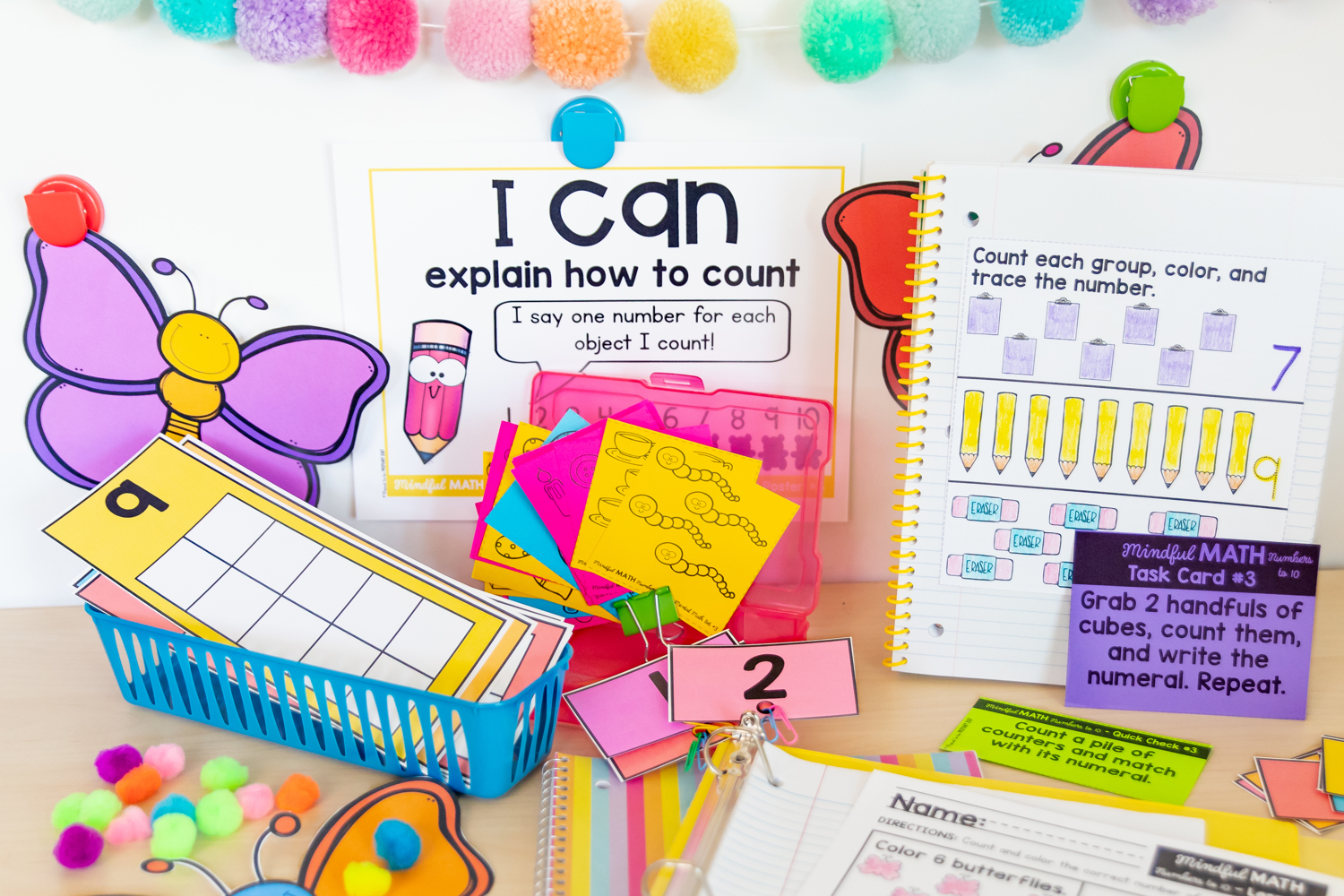
Numbers to 10 Units for Kindergarten and First Grade
The Mindful Math curriculum resources provide everything you need to teach math in kindergarten to 3rd grade. Try one of the Numbers to 10 units that include detailed lesson plans, materials, posters, centers, games, mentor texts, worksheets, quick assessments, math journal pages, warm-ups, mental math ideas, and more!


It’s seriously everything you need to teach the necessary math concepts at your grade level.
Frequently Asked Questions About Numbers to 10
Why is number sense to 10 important?
Number sense to 10 gives students a foundation for understanding quantities, number relationships, addition, subtraction, and other math concepts. A strong understanding of small numbers helps students become more flexible and confident as their math skills develop. Next stop…numbers to 100!
What should students know about numbers to 10?
Students should be able to count objects, recognize numerals, connect numerals to quantities, use one-to-one correspondence, understand cardinality, recognize small quantities through subitizing, compose and decompose numbers, and compare quantities and numbers.
What is the difference between counting and number sense?
Counting is one part of number sense. Number sense involves understanding what numbers represent and how they relate to one another. A student may be able to count to 10 while still needing support with comparing quantities, recognizing numbers without counting, or showing different ways to make a number.
What is subitizing?
Subitizing is the ability to recognize how many objects are in a small group without counting each object individually. For example, a student may look at a group of 4 dots and immediately know there are 4.
How can I help a student who struggles with numbers to 10?
Provide frequent opportunities to work with numbers using concrete objects, visual models, fingers, ten frames, and games. Focus on the specific skill the student is struggling with and give them plenty of opportunities to practice it in different ways.
How can I assess number sense to 10?
Use quick, informal assessments throughout the day. Ask students to identify numerals, count collections, build quantities, compare numbers, recognize dot patterns, or show different ways to make a number. Asking students to explain how they know can also reveal their level of understanding.
When should students master numbers to 10?
Students develop number sense at different rates, so there is not one exact timeline for mastery. Teachers should use developmental expectations as a guide while continuing to provide hands-on practice and support based on each student’s needs.
More Math Ideas & Activities for the Classroom


PIN for Later


[…] Fun and Effective Ways to Teach Numbers to 10 Activities to Teach Students to Count Shapes in Rows – Up to 10 […]