

Discover engaging and fun activities to help kids learn social skills, develop friendships, and encourage strong community building in the classroom.

Building a positive classroom community is like planting a garden. It takes time, effort, and care, but the results are beautiful and bountiful. A classroom where students feel safe, valued, and connected is one where they can thrive academically and socially. This blog post will provide you with a variety of strategies and activities to foster a sense of community in your classroom.
Why Teach Community Building in the Classroom?
Encouraging community building in the classroom is a passion of mine, and here, I will provide you with plenty of activities for kids. These activities can be easily implemented daily to help build social skills, responsibility, and community.
Participating in activities to build classroom community together as a class to help build relationships, problem-solving, and community is extremely valuable. These activities can help build trust and togetherness between peers and their teachers. They also encourage different topics of conversation, opportunities to solve problems, and new experiences.
Being active and sharing also builds teamwork. These activities help a child develop a strong sense of self and solid social skills. The best thing about community building activities is that they are enjoyable and bring out the best in kids.
Community Building During Morning Meeting
Morning meetings are a fantastic way to start the day on a positive note. They provide a structured time for students to share their thoughts, listen to others, and set the tone for the day.
During these class meetings, you can include activities such as “Share Something Good,” where students can share something positive from their school year. This builds a sense of community and helps students start the day with a positive mindset. Additionally, incorporating social-emotional learning (SEL) themes into your morning meetings can help students develop empathy, self-awareness, and relationship skills.
Classroom community activities for kids are great any time of year and any time of day. I use the following as culminating activities after our morning meetings to help bring closure and closeness.
They can be quick and take a few minutes, like a game of “telephone,” or a project that takes longer and has steps, like a STEM activity. How you add your community-building activities to your day is up to you. I suggest finding a gap in time or before or after a transition where an extra activity can be added seamlessly.
Activities for Community Building in the Classroom
Activities to build classroom community can be anything you choose to do as a class together. Activities for P.E. and games you can play on the carpet lend themselves well to this. Below are five community-building activities for kids in the elementary school classroom to connect and strengthen interactions and relationships.
STEM Building Challenges for Community Building
STEM (science, technology, engineering, mathematics) activities and building challenges are great ways to build teamwork and cooperation. Giving students a task they must figure out, plan, and complete together builds problem-solving skills and a sense of accomplishment.
These tactile activities work the mind and the body together. You can create STEM challenges with materials you have ready in your classroom. Give your class a set of materials, a task, or a question, and let them get to work in small groups.

We enjoy using and building marble mazes in small groups. Marble mazes are not simple, especially when there are more than a few people. It requires communication and planning.
We also have a set of red solo cups ready for a quick activity. Give your students a challenge to complete, such as “build the tallest tower using 30 cups,” and let them get to work. Students also love it when you hand them fun team building activities and materials, such as marshmallows, Play-Doh, and some toothpicks and ask them to build a structure.

Here are some must-have materials to get your class started with STEM.
[lasso sitestripe=”true” id=”23521″ ref=”amzn-hefty-party-on-disposable-plastic-cups-assorted-16-ounce-100-count” link_id=”10576″][lasso sitestripe=”true” id=”23495″ ref=”amzn-play-doh-modeling-compound-24-pack-case-of-colors-party-favors-non-toxic-multi-color-3-ounce-cans-ages-2-and-up-amazon-exclusive” link_id=”10577″]
Cooperation & Teamwork Activities for Community Building
Collaborative learning is more than just group work; it’s an opportunity for students to learn from each other and develop teamwork skills. Activities that get kids moving and working together help build cooperation, teamwork, and community. These collaboration activities work well during P.E. class or recess when your class is in a larger, open space. They require a few pieces of equipment found in most schools.
Parachutes are a high-energy activity that requires children to hold onto the edge of a giant parachute and move it up and down. Whenever we play parachute games, there is instant and uncontrollable laughter. Everyone works together to get the parachute to do different things. You can play many games with a parachute (check out Mom Junction’s post with 15 games).

Setting up relays where children must complete a sequence of activities while working as a team with peers is an excellent way to build teamwork. Teaching children to cheer on, encourage others, and show good sportsmanship is essential for success. You can use so many different items to create relays. Hula hoops, skipping ropes, beach balls, and the outside playground set-up work great.
Here is some must-have equipment to get your class started with teamwork activities.
[lasso sitestripe=”true” id=”23542″ ref=”amzn-12-pack-rainbow-inflatable-beach-balls-bulk-for-kids-adults-i-inflatable-pool-party-favors-swimming-pool-toys-i-kids-beach-toys-for-beach-games-i-kids-summer-toys-water-balls-i-toddler-pool-toys” link_id=”10581″]
Get to Know You Games for Community Building
Games, where we learn more about each other, are great for building community and developing a sense of belonging. We feel closer and develop acceptance when we get to know each other better. Playing these get to know you games at the beginning of the year is essential to help students get to know their peers and develop new friendships. They are also fun to play to learn something new throughout the year, especially during classroom meetings.
Get to Know You Game #1: Everyone writes a fact about themselves on a small sheet of paper. Encourage kids to share things that nobody knows already (a summer vacation, an accident, a fear, etc.). Fold up the papers and put them inside the hat. Whenever you have a few extra minutes to fill, pull out a sheet, read it to the class, and have them guess who it is about. After that person is revealed, get them to tell the story of what happened.
Get to Know You Game #2: Complete a self-portrait lesson during art. Once they are complete, collect them and sue them during this game. Put up a portrait of a student. Take turns as a class sharing things they know about that person and nice words (adjectives) about that person.
Communication Games for Community Building
Communication games are a fantastic way to build listening and thinking skills. Children work together to solve problems, listen to questions and answers, and share strategies and ideas. Providing children with opportunities to “play” together builds community and fun into your day. Children love to play these games with a classmate, which are quick and straightforward to implement.
Play “telephone” in a circle as a class or in small groups. Share a message and watch it whispered to each person in a circle. See if the message changes or remains intact. Using a toy telephone makes it extra fun. It also lends itself well to discussions about focusing and listening closely.

Another fun game is Headbanz. Give a student a card to put in their headband that they cannot see. They have to ask questions, and their peers give answers without telling them what is on their cards.
Classroom Jobs for Community Building
Giving students jobs in the classroom builds ownership and respect for one’s classroom. It requires teamwork as children work together to complete tasks and help the teacher around the room.
Consider rotating jobs on a weekly or bi-weekly basis to ensure that every student has a chance to try different roles.
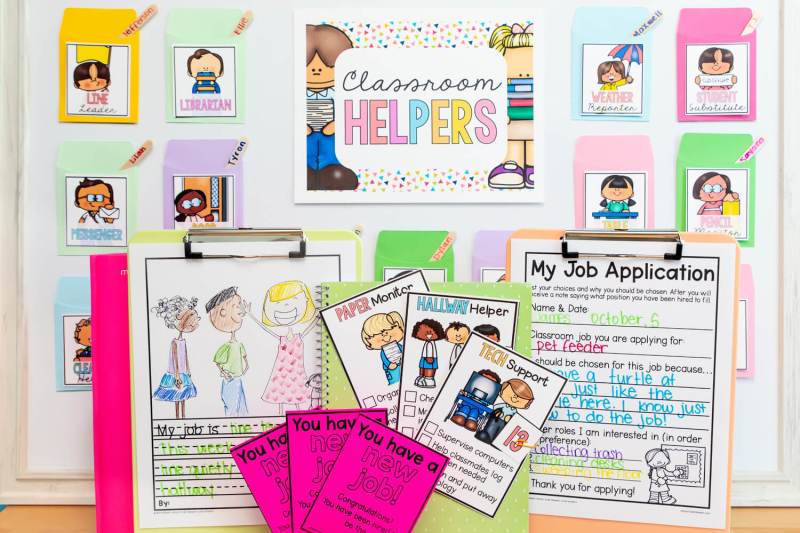
Students love having a job to do each day. They take responsibility for their classroom jobs and, most importantly, put in a good effort with some guidance.
Read more about how I run student jobs in the classroom.
Classroom Transitions
Every class transitions throughout the school day. Take advantage of those times with something fun, quick, and engaging. Use class attention getters anytime you need your class to listen and focus. They respond to the call you give.

Line-up chants are also helpful in readying the class for transitioning through the school. Students work together to repeat the chant aloud with the teacher.
What do YOU do to encourage community building in the classroom? Which activities to build classroom community have you tried?
Social-Emotional Learning
Looking for more lessons and activities to help build community and social-emotional skills? Check out the mind+heart SEL curriculum!

More Resources for Community Building
Create a Classroom Contract
Try the FREE class contract resource. Click the image below to download your copy.


Community Building for the First Week of School

Friendship Activities for the Classroom

Teaching Kindness in the Classroom
PIN IT


Love your ideas a lot! Kids need to attend in some community building activities like these to create basic social skills for them! By taking part in them, kids can be more creative or they would show us their hidden sides.