

Tips for implementing number of the day activities in a primary classroom. Includes free printable for students to fill in with number representations and a number poster.

Number Routine Activities
Many teachers find that incorporating a daily number routine helps kids build a solid foundation in number sense. Think of it like planting a garden: just as you tend to each plant daily to ensure it grows strong, focusing on one number each day helps nurture students’ understanding of math concepts, making them more robust and deeply rooted.
Today, we’ll examine how to run an effective “Number of the Day” routine in your primary classroom. With the right activities and questions, you can make daily practice engaging and enjoyable for your students. These strategies will help your students develop a love for math while mastering essential skills.
Number Sense and Why It’s Important
Number sense is the intuitive understanding of numbers and their relationships, which forms the cornerstone of mathematical reasoning. It goes beyond rote memorization of facts and focuses on a child’s ability to recognize, manipulate, and relate numbers meaningfully.
Developing strong number sense helps students grasp fundamental concepts like counting to 100, comparing, and sequencing or patterns, essential for problem-solving and higher-level math skills. It’s like learning to ride a bike: once you get the hang of balancing and steering, you can easily navigate different terrains. Similarly, a solid number sense allows students to approach mathematical challenges with confidence and flexibility, setting the stage for more complex thinking.
What is the Number of the Day?
Number of the Day is a daily educational routine where students focus on a specific number each day to deepen their understanding of basic math concepts. The routine involves engaging exercises centered around the chosen number, such as writing it, identifying it in different contexts, and exploring it hands-on.

This might include counting objects, drawing pictures representing the numbers, recording numerals, and discussing how numbers relate to everyday life. By highlighting one number at a time, children gain a strong grasp of numerical concepts, improve their counting skills, and develop a solid foundation for more advanced math learning.
Why Use Number of the Day in Early Education?
Incorporating “Number of the Day” into early education is a powerful way to build foundational math skills in young learners. This daily practice helps children become familiar with numbers through repeated exposure, promoting number recognition and counting skills.
By focusing on one number daily, students can engage in various activities like writing, drawing, and identifying in different contexts, reinforcing their understanding.
Additionally, it encourages cognitive development and problem-solving as children explore the number’s properties, such as its place in sequences and its role in everyday life. This simple yet effective routine makes math fun and meaningful, setting the stage for more advanced mathematical concepts.
Classroom Use and Year Round Integration
In the classroom, the Number of the Day Poster Pack can make daily math fun and engaging for kindergarten and first grade kids. During your daily routine, introduce the new number with the colorful poster and discuss it whole class.
Then, dive into hands-on activities like counting objects, drawing numbers, or doing simple math problems related to it in small groups. You can even get the kids moving by having them hop or clap a certain number of times. This keeps them excited and helps them learn the numbers in a lively, interactive way.
To keep the Number of the Day exciting all year long, use the poster pack to focus on a different number each day. Rotate through numbers and revisit them periodically to reinforce learning. Mix things up with number-themed activities—like center work, making art, playing games, or finding the number in real-life situations. For instance, if the number is 7, talk about seven days of the week or seven different animals.
Adding seasonal themes and holiday activities can also keep things fresh and fun. By sticking with this routine, you’ll create an engaging math experience that helps kids build strong math skills throughout the year.
Creating a Poster or Chart
The easiest way to use this routine in your classroom is to create a visual for the kids to reference. As they familiarize themselves with the visual, kids gain confidence and skill. The best way to do this is by creating a colorful chart with all the information the kids need during the daily activity. It can be as simple as a posterboard!
Any bright colors and font cut-outs will do! All you need is a large title, followed by examples for writing and representing the number and a number line.

Using the Routine in the Classroom
Number of the day works well for numbers 1-20. If you teach primary grades, it’s an ideal activity. Study one every week, or you could do more than one. Have each student grab a small whiteboard and erase marker and find a spot on the carpet where they can see the anchor chart. Create a number of the day anchor chart you can reuse each time by laminating it.

Children start by drawing two lines to create a cross on their whiteboards. Go through the different concepts together, then give them a chance to try on their own.
Then, ask for responses and write them down on the class chart. If desired, kids can come up and record what they wrote.
Number of the Day Concepts
- Write the Word: Have posters with the numbers words on a higher wall if they need to look.
- Drawing with Dice: Remind the class that dice only go up to 6 each.
- Tally Marks: I use the short poem “1, 2, 3, 4, number 5 shuts the door, 6, 7, 8, 9, number 10 draws the line, to help kids learn and remember.
- Even or Odd: Have them draw pairs of dots as they count to see if the number has a partner. If it does, then it’s even; if not, it’s odd. Tell them you only need to look at the last digit in a double-digit number.
- Draw a Picture: Let them draw a picture to show their number.
- Ten Frames: Teach them how to draw a ten frame quickly, and then they will draw dots on the frames to show the number.
- More and Less: Show what is 2 and 1 less and more.
- Addition Sentences: Encourage kids to come up with at least one addition sentence that equals the number of the day. This is a great time to review addition concepts like using one’s own fingers, drawing a picture, knowing rules like +0 or +1, flip-flop strategy, counting on, etc. Then, share as a group and have them read and write the sentences we come up with.
- Subtraction Sentences: These are the same as addition sentences, except they start with the number of the day, for example, 14-?=?
- Place Value with Base Ten: Have kids represent the number of days with tens and ones, and possibly one hundred when they reach the 100th day of school.

Watch the kids and what they record. This allows you to easily see how they are doing with the concepts and is a quick check-in assessment.
Benefits of Number of the Day Activities for Building Math Skills
These activities are a fantastic way to build essential math skills in young learners. By focusing on a single number each day, kids get a deeper understanding of how numbers work. They practice counting, recognizing patterns, and building fluency.
They also help develop critical thinking as students explore different ways to represent and work with each number—whether it’s through addition, subtraction, or even visualizing with objects or drawings.
This daily repetition helps strengthen number sense, which is the foundation for all future math learning. Kids become more confident working with numbers, and regular practice helps them retain what they’ve learned.
Plus, because the activities can include fun, hands-on components like counting objects or solving simple math problems, math turns into a positive, engaging experience that students look forward to each day.
Frequently Asked Questions
What age group is ‘Number of the Day’ best for?
“Number of the Day” is ideal for early learners, typically ages 4 to 7, who are just beginning to build their number sense. It’s especially effective in preschool and early primary grades, where children are developing foundational math skills.
How do you set up the routine?
Setting up a “Number of the Day” routine involves selecting a number each day to focus on and planning a series of activities around it. Start by introducing the number through visual aids, such as posters or cards. Then, engage students in activities like counting objects, drawing numbers, and identifying them in their environment. Consistency is key, so incorporate these activities into your daily schedule or math centers to reinforce learning.
What activities can I include in a lesson?
Activities can range from simple counting exercises and recognition games to more interactive tasks like the whole group completing a number of the day sheet or using manipulatives to explore the number’s value. Incorporating movement and hands-on activities can make the learning process more engaging for young students.

How can I make ‘Number of the Day’ engaging for students?
To keep students interested, use a variety of activities and incorporate themes or stories related to the number. For example, if the number is 5, you might read a story about five little ducks or do a counting game with five objects. Incorporating visuals, music, and interactive elements can also enhance engagement. Challenge students who are ready with completing a number of the day worksheet.
How do I assess students’ understanding?
Assessment can be informal, such as observing students during activities and discussions, or more formal, such as using worksheets and quizzes. Regularly check for understanding by asking students to demonstrate their knowledge by counting, writing, or identifying numbers in a variety of different ways.
FREE Number of the Day Templates
Want to create an effective daily number routine that builds number sense skills and fluency with numbers up to 20? Start today with the FREE Number of the Day templates by Proud to Be Primary.
Click the image below to download!
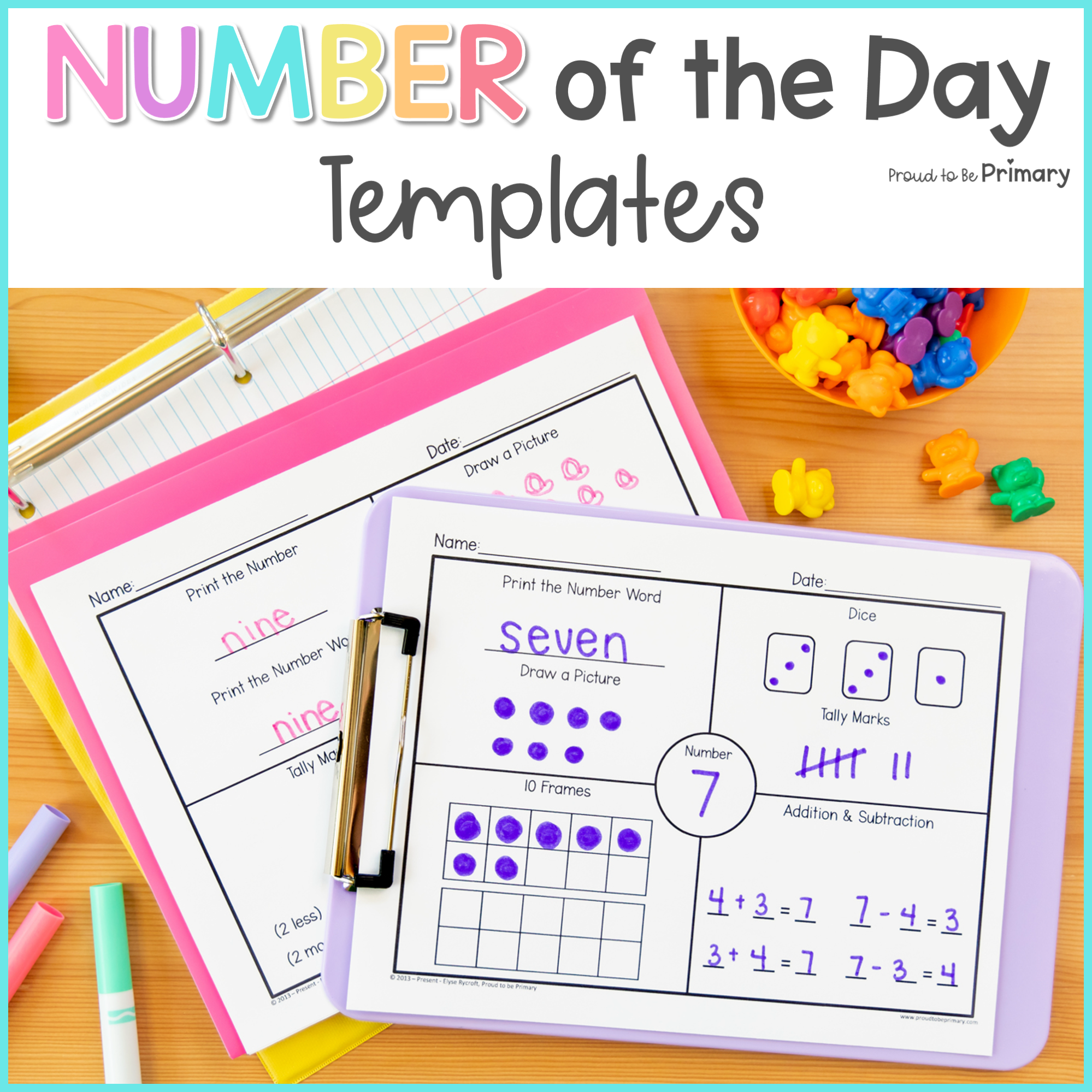
Number of the Day Poster Pack
The Number of the Day Routine Poster Pack by Proud to Be Primary is an engaging way to bring daily math practice of different numbers to life in your classroom.

This Number of the Day Poster Kit resource includes 20 different ways to represent numbers up to 100. Easily build a classroom display for your students to use each day as you discuss numbers in various ways together. Build a display based on what you’re learning in the classroom, and change the representations as needed.
This resource includes:
- 20 different representations to change out as you need for numbers 1 to 100.
- Posters to create a Number of the Day display on your classroom bulletin board, pocket chart, or poster board.
- 13 Differentiated math worksheets to use with any number you are working on.

More Engaging Math Activities


PIN for Later


Thanks for sharing your ideas and freebie, Elyse! I love how including number sentences for addition and subtraction challenges students to use different and higher numbers – automatic differentiation! 🙂
Linda
Thanks for stopping by Linda! Yes it does challenge all students and I like to say to those higher students to show me a new way to represent the number…some very creative ideas usually surface. 🙂
I like this, it is just enough! This is my first year back in first grade after 4 years and I need help getting back on track!!! Thank you! Love how your put it on your board!
Nicole, So glad you like it! I wanted to give something to teachers that I find useful in my class. Elyse 🙂
I love this post! This is very similar to a project my students will have to do for their Student Growth Objectives in the springtime, and these are nice ways to build up to it! Thanks for sharing!
Lindsey 🙂
Forever First Grade
Thanks for commenting Lindsey! I'm glad you found it useful 🙂
Elyse
Love it Elyse!
Lindsey
Lovin’ Kindergarten
Thanks Lindsey!!
I nominated your blog for the Liebster award. Go check out my post and see what it's all about! 🙂 http://createeducateinspire.blogspot.com/2014/02/the-liebster-award.html
Suzanne
Thank you for these great resources. The orig number of the day packet offers good variety. The new poster option offers many of the elements my math specialist suggested I include on laminated mats for student use. You saved me so much time. Thanks again!
I love this idea to work with numbers! I teach kdg. readiness and this is a great way to help them understand the numbers better! Can’t wait to try it!
Thans Elyse. It’s great.
AMAZING! Thank you so much!
HI! I love all of this and look forward to using it with my first graders. Would it be appropriate to use the number of the day as we count each day of school or should I make the numbers more random? I just thought maybe using the same number would be an easy way to incorporate it. Give me your thoughts please!
Hi Michelle. I personally have always used it as we count the days in order. It makes more sense for younger kids building their number sense to see things sequentially build like that. But off course, you could totally mix it up, which would be a fun strategy!
Elyse