
This post may contain affiliate links, meaning I receive a small commission if you make a purchase using these links. As an Amazon Associate, I earn from qualifying purchases at no additional cost to you.
Addition and subtraction activities for kids that build math fact fluency and teach ways of solving word problems in hands-on ways.

Addition and Subtraction Activities For Kids
If you’ve ever caught yourself scrolling Pinterest or Googling addition and subtraction activities for kids late at night, trying to find something that’s actually engaging and not just another worksheet, you’re definitely not alone. Teaching addition and subtraction can feel tricky, and we want students to truly understand the math, not just memorize steps.
The goal is to make addition and subtraction hands-on, interactive, and meaningful through activities, games, and math centers. We want these activities to be easy to plug into daily instruction or send home for extra practice.
These activities, books, math units, and other resource suggestions cover many addition and subtraction concepts. Making planning easier and giving you everything you need to help students learn the ins and outs of addition and subtraction.
Teaching Addition & Subtraction Strategies
Many addition and subtraction strategies should be taught to children when they are young. Learning different strategies helps empower them to choose what works for them. Children tend to rely heavily on using hands-on manipulatives to solve equations when they are young. As they develop new skills and learn new strategies, they build their mental math skills and require math tools less often.
Anchor Chart
Create a detailed anchor chart together as a class or use a pre-made one as a starting point. Take time to discuss each procedure as it’s introduced so students understand not just what to do, but why it matters. As new procedures are taught and practiced, add them to the chart so it becomes a living reference. Keep the chart visible and refer back to it often to reinforce expectations and support student independence.

Using Fingers
The first strategy children will probably learn is how to count, add, and subtract using their fingers. This is an excellent tool for kids because they always have them there to practice using fingers to solve essential addition and subtraction equations within ten. Teach counting on and back using fingers to help solve the more complex equations within 20.

Using Small Objects
Teach children to solve addition and subtraction equations using small objects like snap cubes, counting bears, popsicle sticks, and two-colored counters. These hands-on tools are excellent for tactile learners who need to feel and manipulate to understand and solve.

Number Line Jumps
Number line cards are a simple but powerful tool for solving addition problems. Students can use the card to start at one number and “jump” forward the number being added, visually seeing how the total is reached. In fact, this hands-on approach helps make addition more concrete, reinforces counting skills, and supports students in understanding number relationships.

Part-Part Whole
Snap cubes work especially well when students use two different colors to show the part–part–whole relationship. Students can build each part using a different color of cubes, then snap them together to create the whole. This makes it easy to see how two parts combine to make a total. By counting each color and then counting the whole set, students develop a clearer understanding of how numbers work together.

Addition and Subtraction Story Problems
Teach children how to draw pictures to solve equations. They can draw pictures to represent what they hear in the story or simple shapes to draw things quickly. This helps children visualize and solve problems.

Addition & Subtraction Activities & Games
Hands-on addition and subtraction activities for kids and games give students the chance to really make sense of the math. With consistent practice, those concrete experiences turn into mental strategies students can use on worksheets and in real-life situations. Ultimately, the goal is for students to recognize a problem, choose a strategy, and solve it with confidence.
Fun, intentional addition and subtraction activities for kids help build both understanding and fluency. They can be used as-is or easily adapted to fit different learners. As a result, solving problems together, asking questions that encourage mental math, and prompting students to use familiar strategies all support independence.
Making space for these activities in math centers and free play keeps learning meaningful and engaging throughout the day.
Part-Part Whole
Using physical dominos or domino cards is a great way for students to visualize the parts of an addition sentence. Each side of the domino represents a part, and when combined, they show the whole. Also, manipulating the dominos helps students see number relationships, practice counting, and build a concrete understanding of addition in a hands-on, engaging way.

Addition to 20 Game
Kids naturally love board games, making them an easy way to build in math practice. Using a board game where students must solve an addition problem before moving spaces keeps them engaged while practicing math facts. Each turn has a clear purpose: solve, check, and move, which encourages repeated practice in a fun, low-pressure way. Lastly, these games work well in small groups or math centers and can be easily adjusted by changing the difficulty of the problems.

Dice Game
Games with dice are always a hit with students. Rolling the dice, counting the dots, and adding or subtracting the numbers gives kids a clear visual to support their thinking. The dot representations make number relationships easier to see, especially for developing number sense. These games work well as an independent center, and students stay engaged while practicing key skills.

Addition & Subtraction Word Problems Activities
Children need to learn to solve word problems. As teachers, we must teach them to read a problem, identify critical information, understand what is being asked, and solve it. This is an essential first skill for children to build that will help them solve problems in the future.
The simplest way to teach solving word problems is to give and solve simple problems together as a class. Read the problem slowly together and determine what is being asked. Draw pictures to represent the numbers in the problem. Count along to find the answer and record the equation to show.
Math Journals
Give children math journals and daily word problems to solve independently as part of their routine. This provides consistent practice with applying strategies and explaining their thinking. Additionally, journals encourage students to slow down, model their work, and reflect on how they solved each problem. Over time, this builds confidence, strengthens problem-solving skills, and helps students connect math concepts to real-life situations.

Math Story Booklet
Give children math journals and daily word problems to solve independently as part of their routine. Adding math story booklets gives students a chance to work through a series of connected problems while staying engaged in a meaningful context. As they solve each problem, students can model their thinking and explain their strategies. Using dot-to-dot markers to represent numbers allows students to show quantities quickly and solve word problems in a fun, hands-on way.

Word Problem Task Cards
Read examples of word problems and match them to the equations they represent. To make it interactive, use dry-erase pockets so students can write, erase, and try again as needed. Small objects like counters, cubes, or tokens can be added to help visualize the problems, making abstract concepts more concrete.

Fact Fluency & Mental Math Addition and Subtraction Activities
Eventually, the goal is for students to become fluent in math facts, but this fluency takes time and consistent practice to develop. When children begin practicing math facts early, they build a strong foundation for mental math, which helps them solve problems more quickly and confidently in a variety of situations.
It’s important to remember that the goal is never just rote memorization; students should be encouraged to think about the relationships between numbers and use strategies that make sense to them. Focusing on understanding rather than memorization helps students develop flexible problem-solving skills that will serve them well as they encounter more complex math concepts.
Rainbow Addition Worksheet
The Rainbow Addition worksheet is a fun, visual way for students to practice fluent addition. Students use the numbers at the ends of the rainbow to create addition sentences, connecting the two parts to make a whole. It’s a simple activity that reinforces addition skills and makes practicing math feel more like play than work.

Addition and Subtraction Flashcards
Keep flashcards on rings or in pockets so students can practice independently or with a partner. With answers on the back, they can self-check and build confidence. Flashcards work well for quick daily review, small-group practice, or math centers, helping students strengthen fluency and mental math skills in a hands-on, engaging way.

Addition Rap
Learning an addition rap is a fun, engaging way for students to practice math facts while building memory and fluency. The rhythm and repetition help make number patterns stick, and students often enjoy performing them with classmates.

Commutative Property Activities & Strategies
Children need to understand that addition and subtraction have an inverse relationship, meaning one operation can help check or solve the other. Teaching this concept helps students see connections between numbers and makes problem-solving more flexible. It’s also important to introduce the commutative property, often called the “flip-flop” strategy, so students know that numbers can be added in any order without changing the sum.
Additionally, teaching the associative property helps students group numbers in different ways, making addition easier. Together, these concepts build a deeper understanding of number relationships and support mental math strategies.
Flip Flop Match Game
Play a “flip-flop” match game where students find pairs of equations that show the commutative property, such as 3 + 5 and 5 + 3. This hands-on activity helps students see that the order of numbers doesn’t change the sum, builds number sense, and can be played individually, with a partner, or in small groups for a fun, engaging way to practice.

Fact Families
Teach students about fact families to show the connection between addition and subtraction. Explain that three numbers can create four equations, two addition and two subtraction, which helps students see how numbers relate. Using fact families strengthens mental math skills and lays a foundation for more complex problem-solving, especially when paired with hands-on activities such as manipulatives or number triangles.

Tips for Teachers
Addition and subtraction practice doesn’t have to be limited to math time. You can easily weave it into different parts of the day:
- Morning routines: Count students’ attendance or the number of supplies in a bin.
- Storytime connections: Solve simple addition or subtraction problems related to the story.
- Centers or small groups: Use hands-on activities, math manipulatives, or games like dominoes and number line cards.
- Free play or choice time: Include flashcards, board games, or dot-to-dot addition sheets.
- Real-life situations: Counting snacks, organizing classroom materials, or setting the table.
All in all, by practicing throughout the day, students strengthen mental math skills and see math as meaningful in everyday contexts.
FAQ
Q: What grades is Mindful Math designed for?
A: The Mindful Math Program is ideal for primary grades, especially K–2, but many activities can be adapted for older or struggling learners.
Q: Do I need any special materials?
A: Most activities use common classroom items like counters, cubes, dominoes, or dry erase markers. Tons printable templates are included for convenience.
Q: Can it be used in small groups or centers?
A: Yes! The program is flexible and works for whole-group lessons, small groups, math centers, or even independent practice.
Q: How do I track student progress?
A: Many of the practice pages and activity templates allow for easy recording of student responses and growth over time.
Making addition and subtraction engaging doesn’t have to be complicated. With the Mindful Math program, hands-on addition and subtraction activities for kids, and simple strategies throughout the day, students can build number sense, fluency, and confidence in a fun, meaningful way. By weaving practice into everyday routines, teachers can help students develop strong math skills while keeping learning enjoyable.
Resources for Addition & Subtraction
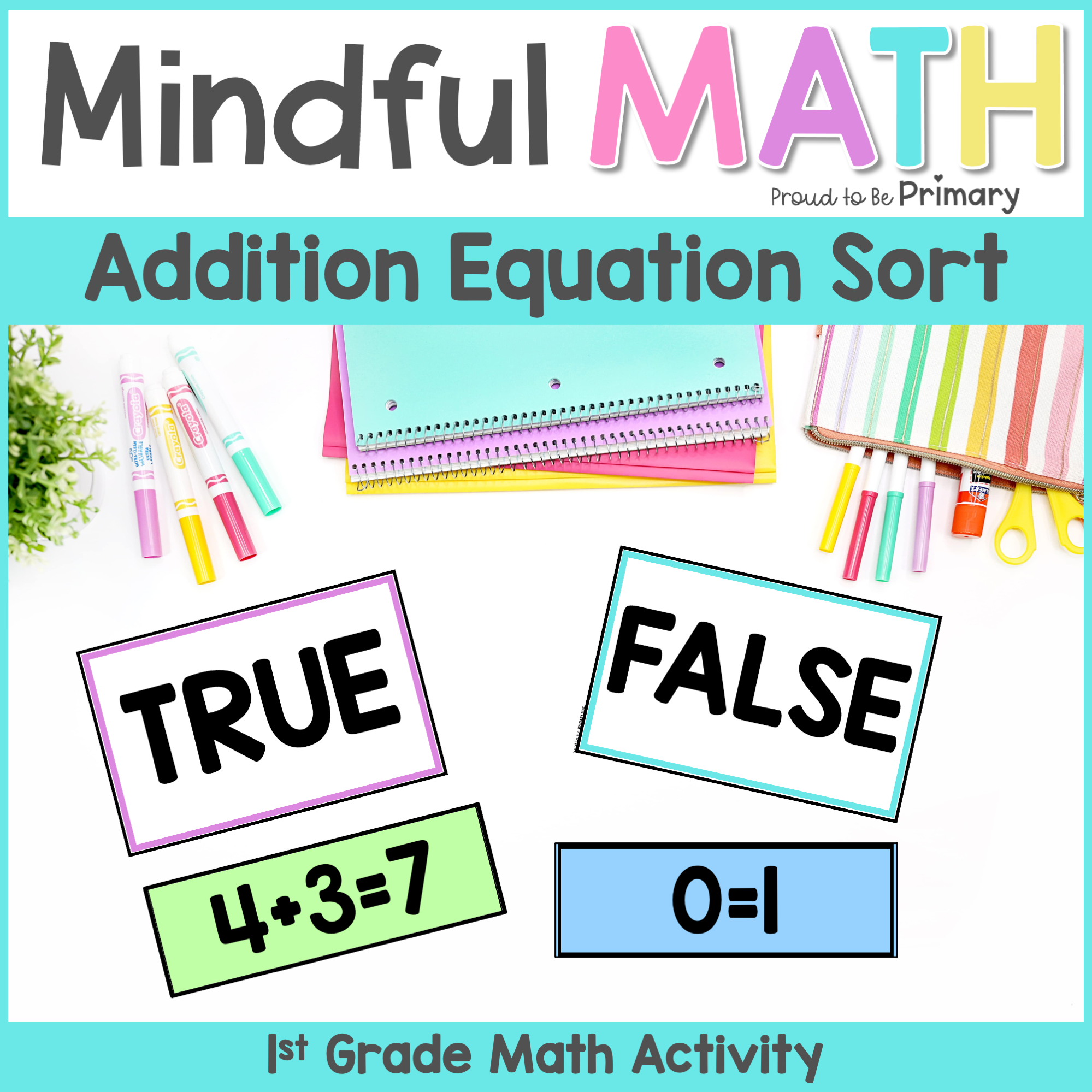
Free True or False Addition Equation Sort
Grab this FREE True or False Addition Equation Sort to help students understand the meaning of the equal sign! This hands-on activity lets kids practice determining whether addition equations are true or false. Plus, it helps build a strong foundation for number sense and equation fluency. Perfect for small groups, math centers, or independent practice!
Click Below to sign up for your free copy.
Mindful Math Comprehensive Program
Try the Mindful Math Program by Proud to be Primary. It includes everything you need to teach addition and subtraction with confidence: lesson plans, hands-on activity templates, and engaging practice pages. It takes the prep work out of the way so you can focus on making math meaningful, fun, and memorable for your students while building strong number sense and problem-solving skills.
- Addition to 10 Math Unit Kindergarten
- Subtraction to 10 Math Unit Kindergarten
- Addition to 10 Math Unit First Grade
- Addition to 20 Math Unit First Grade
- Subtraction to 10 Math Unit First Grade
- Subtraction to 20 Math Unit First Grade
- 2-Digit Addition Unit Second Grade
- 3-Digit Addition Unit Second Grade
- 2-Digit Subtraction Unit Second Grade
- 3-Digit Subtraction Unit Second Grade
You’ll appreciate these 2-digit addition strategies for 2nd and 3rd graders!
More Fun Addition and Subtraction Activities


Addition Subtraction Fact Fluency
PIN FOR LATER


