

This post may contain affiliate links, meaning I receive a small commission if you make a purchase using these links. As an Amazon Associate, I earn from qualifying purchases at no additional cost to you.
A classroom teacher explains her experience running a weekly class meeting, including tips, tricks, and advice for improving the classroom routines to create a positive atmosphere.

Your Class Meeting: Make it Effective EVERY Day
In this post, I will share how to run effective classroom meetings, with a schedule and specific plans to help children learn and apply interpersonal skills for their social-emotional well-being. I hope you can implement these strategies to start your own classroom meetings or improve your routines and outcomes.
Why Have a Class Meeting?
I strongly advocate for teaching and reinforcing social responsibility at school. Class meetings let you teach what isn’t written in your Math, Reading, or Science curriculum but is equally important and deserves your time.
Children will learn how to express feelings and emotions in constructive ways. They will learn to manage anger and calm themselves down. In addition, they will build the skills needed to solve problems independently. They will also learn to make and maintain healthy friendships by listening, expressing themselves, taking turns, and playing games. Most importantly, effective classroom meetings create opportunities for the class to connect, share, and learn from each other. Through sharing our good and bad feelings, we can relate to each other. We can share what we are thankful for, give compliments, and solve problems together. Classroom meetings help us grow as a group and as individuals.
Having taught class meetings in primary classrooms over the years, I have seen great results. I have seen children learn to cope and handle difficult situations with ease. In addition, I have witnessed children go from needing a lot of help to deal with anger and issues with friends to being completely 100% independent in doing so. Therefore, I hope that you will see similar results.

The Class Meeting Schedule
Classroom meetings can take place at any point during the day and for as long as you see necessary. I prefer to hold our meetings on Friday afternoons. That is the day and time we finish up work and decompress from the week. Children have just completed a full week of activities and playing with friends. They often have plenty to talk about and share. Our meetings usually last about 30 minutes to 1 hour, depending on the lesson and how much talk time we need.
Opening the Class Meeting
We start every class meeting sitting together in a circle on the carpet. I like to set an intention for the meeting to help children focus and get ready to listen. We use our chime and some deep, quiet breathing to clear our heads and calm our bodies.
I review a few rules for respectful listening (looking at the speaker, listening to what they are saying, and keeping a calm body). We remind ourselves that only the person with the “talking stick” (or whatever item you choose for children to hold when it’s their turn to speak) may talk. We wait for everyone to look and sound ready, and we begin.
Temperature (Sharing Feelings within the Class Meeting)
We take turns going around the circle and passing our “talking stick” or another item. We take turns giving our temperature out of 10 to express how we are feeling at the time (0 being not good and 10 being great). Children can say their temperature and give a reason if they wish. For example, I am an 8 because I played a fun game of soccer with my friends at lunch. As we go around the circle, if children are not ready for their turn, they can pass, and we will come back to them.
During our first meeting, we spent a lot of time learning about the 0-to-10 scale. I encourage children to think about their feelings on this scale and how even if they are having a bad day, they are probably not a zero. This requires practice and help. I give examples along the scale to illustrate this. A small chart of the scale on a number line with examples is helpful.
Gratitude (Giving Thanks during the Class Meeting)
This is another variation to include instead of temperatures during meetings. Take turns going around the circle and expressing gratitude for something. It can be absolutely anything. We use the words “I am thankful for…” when the talking stick comes to us. For example, I am thankful for the nice weather outside, or I am thankful for my mom because she takes good care of me.
Again, we spend time learning about gratitude at first. We share what we are thankful for and brainstorm ideas on a chart for future reference. I encourage children to be authentic and to think with their hearts when it is their turn. Some children prefer to use an idea from the chart or one they heard from a friend, which is fine as well.
Bouquets (Giving Compliments during the Class Meeting)
I teach children that a bouquet is something you give someone you care about to say something special. Giving each other compliments and saying nice things is like giving a friend a bouquet. This helps children visualize the importance of saying nice things. During our first meetings, we discuss how it feels when someone says something kind to us and brainstorm different compliment ideas. Students learn the difference between a “surface” compliment (I like your haircut!) and a “deeper” compliment (You are a kind friend!). Together, we talk about how deeper compliments, which focus on our character and who we are, can feel more meaningful and require more thought.
Children put up their hands to take a turn giving a bouquet to a friend in the circle. We practice, and I support them in using the line “I have a bouquet for… because…” These are very powerful! Often, as children give their bouquets, more hands go up as others remember things they want to express to their peers and appreciate. Not everyone has to give a bouquet during a meeting, just those who want to.
Beefs (Using the Class Meeting for Problem Solving)
Children need to learn problem-solving strategies that they can eventually use independently. During the “beefs” portion of effective classroom meetings, we talk about and learn problem-solving strategies. This requires teaching ahead of time about the different ways to solve a problem.
Teach students that when a problem occurs, they can do a few different things:
- Tell the person to “STOP”
- Say how it makes them feel: “It makes me feel… when you…!”
- Suggest a solution to the problem
- Walk away and leave the situation
- Get help from an adult you know
Set a few rules during this time to avoid intentionally hurting feelings. Limiting the number of “beefs” expressed during a meeting to 3 or 4 is helpful. I also have a rule against naming friends in our classroom or school as the problem to maintain respect. As adults, we wouldn’t want to be “called out” for our mistakes in front of our peers, so we don’t want our students doing that to each other either.
If a child has a problem and has a hard time solving it on their own, they are encouraged to share it with the class. They are asked to explain the problem and then take 4 suggestions from the class on how to solve it. Their problems usually consist of issues with cooperation, sharing, taking turns, and, unfortunately, bullying and negative physical contact.
An example of a typical problem: At lunch, I wanted a turn on the swings, but nobody would let me. Examples of typical solutions: You can ask nicely and say, “May I please have a turn?” or find something else to do on the playground instead. I let the class share their suggestions first, then I share my own thoughts, usually to reinforce what they’ve already said. Sometimes children aren’t sure which problems they should solve on their own and which require adult help (bullying and any negative contact). This is a great opportunity to teach this.

Social Emotional Learning (Discussion/Lesson/Book)
This is the culminating part of an effective classroom meeting. This part can take on any shape or form depending on what you want to teach your class or what your needs are. Please see how the week goes and identify any issues that need to be addressed. Or you may want to have a short discussion with your class after reading a book about the topic. You could discuss it and have students write and draw about what you covered. You might also have students role-play different scenarios and discuss their feelings. Finally, you may choose a separate lesson and activity to build a specific social-emotional learning area.
Your school or district may have a specific social responsibility or SEL program they prefer, with lessons for you to choose from. You can usually attend conferences and workshops to learn different approaches available to teachers. The Social Emotional Learning Curriculum mind+heart is a comprehensive program perfect for K-2 and includes 8 units filled with lessons and activities to add a ton of value to your class meetings. Other programs I have used in my classroom and especially like are Roots of Empathy, Mind-Up, and Restitution.
Topics for lessons
During each week, I have AT LEAST one meeting and a lesson on a specific social and emotional learning topic. Some of these ideas are listed below.
- Self-regulation (expressing emotions appropriately, calming down, self-control)
- Friendship skills (taking turns, sharing, listening)
- Empathy (caring about others, thinking of others before ourselves, helping others)
- Bullying (how to stop it, how to recognize it)
- Conflict resolution (problem-solving skills)
- Respect (recognizing differences, appreciation, acceptance, kindness, love)
- Cooperation and responsibility (for oneself, with others, in the classroom and school)
- Basic needs (versus wants)
Find everything you need for an entire year of class meetings in the mind+heart SEL curriculum. Available for K-2 and 3-5.
Class Meeting Must-Have Book List
Books can be a very powerful tool in expressing what is sometimes difficult to explain. They offer another perspective and example of what we discuss. I like to keep a box of special books for classroom meetings. I pull them out to share with the class and support our discussions. The following books are highly recommended. I own each book and have read it to children successfully over the years.
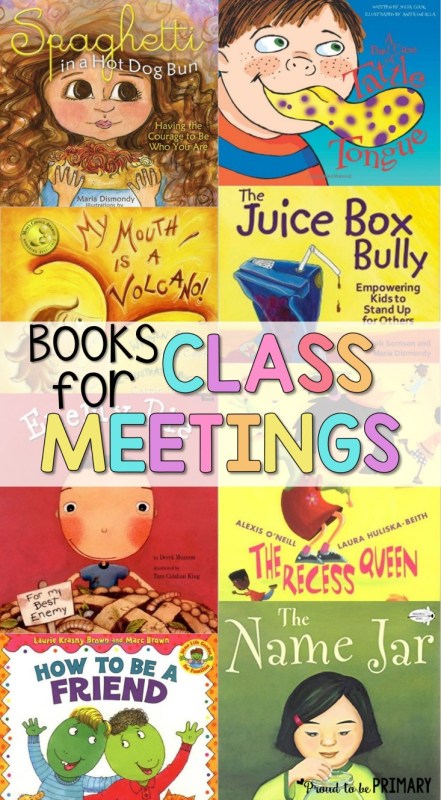
- How to Be a Friend: A Guide to Making Friends and Keeping Them by Brown
- Two by Otoshi
- The Name Jar by Choi
- My Mouth is a Volcano by Cook
- Bad Case of the Tattle Tongue by Cook
- Interrupting Chicken by Stein
- The Juice Box Bully by Sornson
- Stop Picking on Me by Thomas
- Spaghetti in a Hot Dog Bun by Dismondy
- Enemy Pie by Munson
- The Recess Queen by O’Neil
- You’re Mean, Lily Jean by Wishinsky
- How Full is Your Bucket? For Kids by Rath
- Chrysanthemum by Henkes
- The Way I Feel by Cain
- The Way I Act by Metzger
- How Are You Peeling? by Freymann
Community Building Activity
As a final quick activity, I like to do something fun as a class. We usually play a game or complete a teamwork activity. I start the year by teaching the class a few games and activities that we can use throughout the year. We use the community-building activities for kids weekly to help us stay connected and have fun together!
Classroom and Morning Meeting Resources
Free Week of Morning Meeting
Try social-emotional morning meetings in your classroom with this FREE week-long resource! It includes editable PowerPoint and PDF slides, printable cards, and instructions. Click the image below to grab a copy.

mind+heart SEL Morning Meeting Bundle
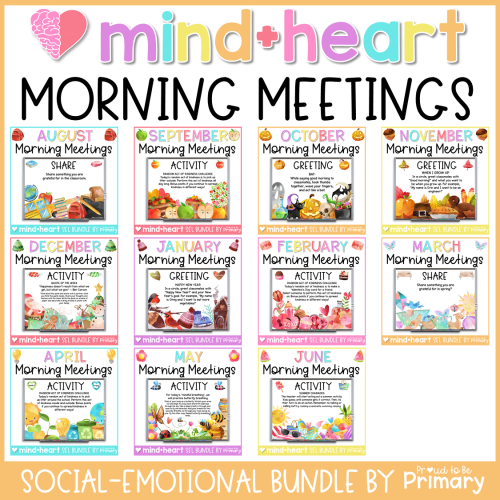
Transform your classroom with a daily 15-minute morning meeting. Get everything you need for a daily meeting in this HUGE bundle. The SEL Morning Meeting Bundle is everything you need to manage the classroom routines first thing!
mind+heart Social-Emotional Learning Curriculum
Looking for more lessons and activities to help build community and social-emotional skills? Check out the mind+heart SEL curriculum!

More Ideas to Build Classroom Community

The ultimate social-emotional learning guide

The Ultimate List of Classroom Management Strategies

Community Building Activities You NEED

Teaching Respect in the Classroom
PIN IT


