
This post may contain affiliate links, meaning I receive a small commission if you make a purchase using these links. As an Amazon Associate, I earn from qualifying purchases at no additional cost to you.
A guide to teaching money and coins in grades K-2: Find ideas, activities, tools, games, and books to make your lessons effective and fun.

Teaching Money and Coins to Kids
We all remember the first time we gave students plastic coins for a classroom store. They are always beyond excited! That was the moment I realized just how important it was to teach young kids the real value of money—not just how to count it, but how to make smart choices with it.
Teaching money concepts in primary school isn’t just about recognizing coins and bills; it’s about setting the foundation for lifelong financial skills. Whether through hands-on activities like a pretend grocery store, games that teach saving and spending, or interactive lessons on needs versus wants, helping kids understand money early can have a huge impact.
So, let’s dive into some fun and practical ways to teach primary students about money!
Activities and Methods for Teaching Money and Coins
When it comes to teaching money and coins, hands-on activities make all the difference. Kids learn best when they can touch, see, and play with real or pretend money, turning abstract concepts into something tangible. These activities help young learners build a strong foundation in financial literacy while having fun. Here are some engaging and effective ways to teach primary students about money!
General Concept of Currency
In the beginning, kids need to understand the general concept of currency and its importance in our daily lives. The first thing kids must understand is why we have money. Here are some ideas to get kids to see the broader concept behind currency and how it works.

- Hold a barter day—Have kids bring in a cheap item or two and allow them to barter with each other to obtain another object from someone else in the class.
- Goods and Services—Explore the idea of goods and services by having kids categorize pictures according to whether they show a thing or a service being performed. Show kids that there are different ways to spend money and the relative value of each good or service.
- Needs and Wants—Discuss the difference between wants and needs. Give kids cards with pictures on them and let them decide if the object is a need or a desire. Allow them to defend their answer if it is not an obvious one for some lively discussion!
Identify and Describe Money and Coins
Being able to identify coins by name and value is obviously an important skill to have. Here are some simple ways to reinforce learning to identify coins.

- Visual Examples—Let kids interact with and hold larger-than-life bills and coins in their hands. These manipulatives help them become familiar with them. For example, they are magnetic, so the kids can use them in a variety of ways.
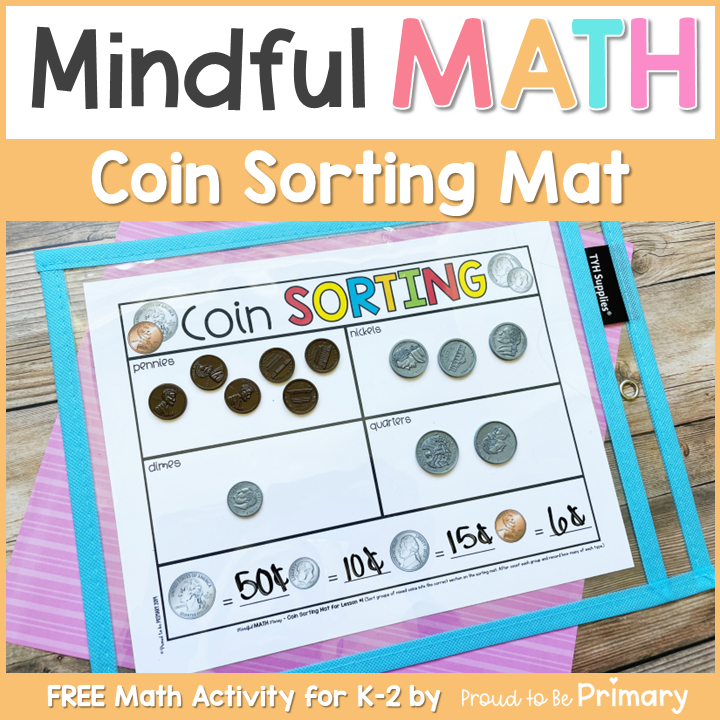
- Sorting – Place a sectioned vegetable tray with coins in the middle of the table. Label one pile “pennies,” another “nickels,” and so on. Have the kids sort the coins into the appropriate section. Grab a free printable sorting coin mat below!
- Coin Rubbings – Make coin rubbings by placing coins under the paper and using a colored pencil to produce the image on the paper. Then, kids can match actual coins to the rubbings.
- Flip a Coin Money Game—Create a coin toss graph by recording the number of heads and tails in a specified number of tosses. Use different coins! This activity can familiarize the kids with the specific pictures on the coins.
- Video – Watch this fun video from NUMBEROCK about coins and their values.
Count, Represent, and Order Money Amounts
Once kids can identify coins and know their value, they can start to add money. There are many ways to practice.

- Bingo – Make it fun with BINGO! Kids will love competing with this money bingo game, which challenges them to count the coins as you call the totals.
- Counting by Increments – Have students learn to count coins by reviewing how to count by 1, 5, 10, and 25. They can demonstrate this knowledge on printable resource sheets.
- Plastic Cups – Use readily available and relatively inexpensive plastic cups to provide hands-on practice. Write prices on the fronts of plastic cups, then let students place the correct change in each one.
- Hide and Seek – Play with coins! An adult hides them around the classroom. Then, the kids look for and collect the coins. When they find them, they must add to find their total. You could offer a prize to the winner with the most money, or for accurate counting, or for who found the most quarters, etc.
- Coin-Counting Story Problems – Give kids cards with stories involving money and have them work together to come up with the answers.
- Coin Caterpillar – Create a coin caterpillar by lining up coins and tracing them on paper to make them look like caterpillars. Let the kids count them and write down the total value of their caterpillar.
Financial Transactions & Literacy
If kids can count money, it is time to put that skill to use and see how it plays out in a more “real-world” situation. Below are a few ideas for ways to make the monetary system more alive for the students.

- Board Games – Play Monopoly, Jr. This easier version of the original game is suitable for ages five and up. It lets kids have fun while learning to manage their money and make wise decisions.
- Play Pretend – Set up a learning center as a grocery store or other store. Let kids play with a pretend cash register and pretend money.
- Let them “Shop” as a reward – Have a clear jar for each child and let them earn coins and dollars. When their jar is full, they get to purchase at a class store to buy something as a reward for their work.
- Value of Real-Life Products – Give each child a specified amount of money and let them “go shopping” by looking through store flyers and choosing things to buy.
- Add and Subtract with Word Problems – Students view a story about an exchange of money and answer the question, practicing their understanding of adding and subtracting money.
Online Learning
Many resources are online if you’re looking for an alternative way for kids to practice measurement! These math websites allow kids to practice (and master) math concepts, including measurement.

Children’s Books about Money
Use these great books for kids to teach money and its value. These would make a great addition to your classroom library. Pull them out for your math lessons!
- One Cent, Two Cents, Old Cent, New Cent: All About Money by Bonnie Worth is a great book for teaching kids about money, including its history. It is written in a catchy Dr. Seuss style.
- Lots and Lots of Coins by Margarette Reid – This book introduces kids to the history of currency in a way that is easy for them to grasp.
- A Dollar, A Penny, How Much, and How Many by Brian P. Cleary – Cats make learning about money fun in this book about coins and bills. Kids will enjoy the catchy rhymes and goofy pictures.
- The Coin Counting Book by Rozanne Lanczak Williams provides a straightforward approach to identifying and adding coins.
- The Penny Pot by Stuart J. Murphy – Kids learn to count money at a face-painting booth.
- The Berenstain Bears: Trouble With Money by Stan and Jan Berenstain – Brother and Sister Bear learn about managing money in this classic book.
- Deena’s Lucky Penny: Money by Barbara deRubertis—Kids will see the practical application of money when Deena needs to buy her mother a birthday gift.
- The Great Pet Sale by Mick Inkpen: Kids explore simple addition with pennies by imagining themselves at a giant pet sale!
- You Can’t Buy a Dinosaur with a Dime by Harriet Ziefert – Help Pete problem-solve with his money as he decides what to spend his allowance on.
- Pigs Will Be Pigs: Fun With Math and Money by Amy Axelrod – The pig family must collect and count all of their money to have enough to go out to eat for dinner.
Resources for Teaching Money and Coins
Want to take your child’s money skills to the next level? Check out the Mindful Math resources, which contain nearly everything you need to create a comprehensive unit on money for 1st, 2nd, & 3rd grade! You will find so many resources here (including a Canadian version).
- Graphing, Money and Financial Literacy- First Grade Mindful Math
- Money to 500¢ (coins & bills)- Second Grade Mindful Math
- Money and Financial Literacy – Third Grade Mindful Math
Grab a FREE Coin Sorting Activity
Grab your free copy of the Coin Sorting Mat by clicking the image below and signing up!
Hands-On Tools for Teaching Money
Every teacher knows that any opportunity to teach with hands-on materials is beneficial for the many types of learners in the classroom. Here are a few favorites from teachers in classrooms just like yours.
- Pretend Money – There are so many ways to use this play money. Letting the kids interact with it helps improve their skill level.
- Laminated Money Chart – This is a handy reference to have available for kids to see throughout the day.
- Money Match Me Cards – Let kids make matching coins and totals into a game!
- Money and Time Learning Mats – These handy learning mats come with activity ideas.
- Cash Register – This can be used for kids to practice making change
- Learning Resources Money Activity Set – This set contains useful things to help make learning about money fun.
- Money Bags Coin Value Game – Use this board game as a fun way for kids to practice money while enjoying a competitive game.
- Exact Change Card Game – Similar to UNO in a way, this card game helps kids calculate the value of money in their heads to make matches to win.
- Pretend to Spend Wallet – Place these in a learning center set up as a storefront, and watch the pretend play teach your kids.
When you use any of the above methods for teaching money and coins, you’ll ensure success with all the learners in your classroom. Let me know in the comments how you’ve used these or other ideas!
More Math Ideas and Activities

Measurement Activities for Kids


PIN for Later


