

Morning meeting games are a great way to start the day in any elementary school classroom. Use morning meeting games to start each day on the right foot. Get students engaged and in the right mood from the start!

Morning Meeting Games for the Classroom
The first few minutes of the school day can be some of the trickiest. Students arrive at different times, unpack backpacks, transition into “school mode,” and try to wake up enough to engage. At the same time, you’re managing the morning routine while building a classroom community where students feel comfortable, connected, and ready to learn.
Instead of jumping straight into a worksheet or assignment, a quick morning meeting can help everyone ease into the day. These simple activities get students talking, moving, laughing, and interacting with their classmates while naturally building social-emotional skills like communication, cooperation, and listening.
You don’t need a complicated game or a huge chunk of instructional time. A short, intentional activity can create a more positive classroom climate, help students transition into the school day, and get them engaged before learning begins. If you can get a room full of sleepy students smiling and participating before 9 a.m., that’s a win!
Why Morning Meeting Games Matter
Morning meeting games are about more than simply having fun before the school day begins. Those first few minutes let students transition into the classroom, connect with classmates, and shift into learning mode. A short, engaging game can make a noticeable difference in how students enter the rest of the day.
Build Classroom Community
Games give students a chance to interact with classmates in a relaxed, low-pressure setting. Whether they’re working with a partner, joining a whole-class challenge, or laughing together over a silly question, these shared experiences help students feel like they belong.
Get Students Engaged
Let’s face it: not every student walks through the door ready to learn. A quick game can grab their attention much faster than a worksheet waiting on their desk. Five to ten minutes of movement, conversation, or problem-solving can help wake up sleepy brains and get students ready to participate.

Support Social-Emotional Learning
Many morning meeting games naturally reinforce SEL skills. Students practice taking turns, listening, cooperating, communicating, managing emotions, and responding appropriately to others. You can build these skills without making every activity feel like a formal SEL lesson.
Create a Positive Classroom Climate
Starting the day with something positive can set the tone for what follows. When students feel welcomed, connected, and excited to participate, they’re more likely to carry that positive energy into the rest of the school day.
Establish a Consistent Routine
A morning game can also become a predictable part of your daily routine. Students know what to expect when they arrive, which can make the transition from home to school feel smoother. The routine doesn’t have to be elaborate, just consistent enough to give students a positive way to begin the day.
You only need a few minutes. A 5–10 minute game may seem like a small addition to your morning, but those minutes can help students connect, build important skills, and arrive at learning feeling more focused and ready to go.
When Is the Best Time to Use Morning Meeting Games?
The best time to use a morning meeting activity is right at the beginning of the school day. As students arrive at school, they transition from home, settle in, and prepare their minds for learning. Rather than expecting everyone to immediately pull out a worksheet and get to work, use those first few minutes to welcome students with something fun and engaging.
Since morning meeting is often one of the first activities of the day, it provides a natural place to add a quick game. A 5–10 minute activity can serve as a warm-up that helps students wake up, connect with their classmates, and get ready to participate.
Make Games Part of Your Routine
Prep morning meeting activities for each day of the week so you always have something ready. Planning ahead means you aren’t scrambling for an idea while you’re taking attendance, answering questions, and trying to get everyone settled.
You can even create a predictable schedule for your games. For example, Monday could be a movement game, Tuesday a partner challenge, Wednesday a Would You Rather activity, Thursday a teamwork activity, and Friday something silly or celebratory. Students will quickly learn what to expect and may even start looking forward to the morning activity.
Use Games to Ease the Morning Transition
Not every student walks into the classroom ready to learn. Some may be tired, distracted, or still thinking about what happened at home. A quick game gives them a chance to make that transition gradually, rather than expecting them to go from “I just walked through the door” to “Let’s get out our pencils and start working.”
Games that include movement, conversation, laughter, or problem-solving can help students become more alert and engaged. They also provide a natural opportunity to interact with classmates before diving into academic work.
Keep It Short and Simple
You don’t need to spend 20 or 30 minutes playing a game. In most cases, 5–10 minutes is plenty. Choose activities that require minimal setup and have simple directions so the game doesn’t become another complicated routine you have to manage.
If you can manage it, try to offer one quick game or activity each morning. Consistency matters more than complexity. When students know that their day begins with a fun opportunity to connect and participate, those few minutes can become one of the routines they look forward to most.
Tips for Choosing the Right Game
Not every morning meeting game will work for every class, and that’s okay! The best activities match your students, your schedule, and the kind of energy you want to create that morning. When choosing a game, think about what your students need in that moment rather than simply picking the most exciting activity.
Keep It Short
Morning games should fit easily into your schedule. Look for activities you can complete in 5–10 minutes, so you have enough time for your morning routines and academic instruction.
Consider Your Students’ Energy Level
Pay attention to how your class is feeling that morning. If students are sluggish, choose something involving movement. If they’re already bouncing off the walls, a quieter partner game or thinking activity may be a better choice.
Choose Games With a Purpose
Fun is important, but your morning games can do double duty. Look for activities that encourage speaking and listening, teamwork, problem-solving, movement, creativity, or social-emotional learning. You can have fun while still building important skills.
Make Sure Everyone Can Participate
Choose games that don’t leave students sitting on the sidelines for long periods. Activities where everyone can respond, move, think, or participate at the same time help keep the entire class engaged.
Keep Directions Simple
The last thing you need first thing in the morning is a game that requires a ten-minute explanation! Choose activities with simple rules and demonstrate what students should do before you begin. As students become familiar with your morning game routine, they’ll need fewer directions.
Mix Up the Types of Games
Variety keeps students interested. Rotate between movement games, partner activities, whole-class challenges, discussion games, brain breaks, and SEL activities. A mix also lets you choose a game based on what your class needs that day.
Think About Your Classroom Space
A game that requires students to move around the room may not be the best choice when desks are packed together. Before adding an activity to your morning routine, consider how much space, materials, and preparation it requires.
Don’t Be Afraid to Repeat Favorites
You don’t need a brand-new game every single day. If students love an activity, bring it back! Familiar games often run more smoothly because students already understand the expectations, allowing you to spend less time explaining and more time enjoying the activity together.
Remember: The “right” morning meeting game isn’t necessarily the loudest, funniest, or most elaborate one. It’s the one that helps your students connect, engage, and feel ready to start the day.

Active Morning Meeting Games
When students arrive with extra energy, give them an appropriate way to use it! Active morning meeting games help students wake up their brains, get their bodies moving, and practice listening and self-regulation before the academic part of the day begins.
1. Act It Out
Act It Out is a quick way to get students out of their seats and having fun. Students act out different actions while classmates guess what they’re doing.
- Objective: Encourage movement, creativity, and participation.
- Materials: Optional class brain break activity cards
- How to play: Choose an action for a student to act out without speaking. The rest of the class guesses the action.
- Skills practiced: Movement, communication, listening, confidence, creativity.
- Younger students: Use simple actions such as jumping, swimming, or brushing their teeth.
- Older students: Let students create their own actions or use more challenging scenarios.

2. Four Corners
Four Corners turns a simple question into an opportunity for movement and conversation. Students move to the corner that represents their answer and can see how their classmates responded.
- Objective: Encourage decision-making, movement, and discussion.
- Materials: Four signs or labels.
- How to play: Give each corner of the classroom an answer to a question. Students move to the corner that represents their choice, then discuss or compare their responses.
- Skills practiced: Movement, decision-making, speaking/listening, math.
- Younger students: Use pictures and simple choices.
- Older students: Have students graph the results or compare the number of responses in each corner.
3. Questions with a Hoop
Add a little fun to your morning meeting questions by letting students shoot a basket after they answer. This is especially helpful when you want to add movement without requiring a full movement game.
- Objective: Encourage conversation while adding a physical activity.
- Materials: Mini basketball and hoop or wastebasket.
- How to play: Ask students a question and invite them to answer. After sharing, they get a chance to make a basket.
- Skills practiced: Speaking/listening, confidence, movement, connection.
- Younger students: Use simple favorite-things questions.
- Older students: Ask SEL, problem-solving, or opinion-based questions.
4. Freeze Dance
A quick dance break can be exactly what students need to wake up and get ready for learning. Freeze Dance combines movement, listening, and self-control.
- Objective: Encourage movement while practicing self-regulation.
- Materials: Music and a device to play it.
- How to play: Play music while students dance. Stop the music at random times and have students freeze until it starts again.
- Skills practiced: Movement, listening, self-regulation, coordination.
- Younger students: Add simple movements for students to copy.
- Older students: Let students take turns choosing movements or leading the game.
5. Stand Up, Sit Down
This simple game gets everyone participating at the same time and can help you learn fun facts about your students. It’s also an easy way to add movement without turning your classroom into complete chaos.
- Objective: Help students find common interests and experiences.
- Materials: None.
- How to play: Call out statements such as “Stand up if you have a dog!” or “Stand up if you like pizza!” Students stand if the statement applies to them and sit back down before the next one.
- Skills practiced: Listening, movement, self-awareness, connection.
- Younger students: Use familiar statements and demonstrate how to do it.
- Older students: Allow students to create statements for the class.

6. Quick Draw
Quick Draw gives students a low-pressure way to respond to a morning prompt without speaking in front of the whole class. It’s especially useful for creative students or mornings when you want to add a few quiet minutes to your routine.
- Objective: Encourage creativity, reflection, and communication.
- Materials: Paper and pencils, crayons, or markers.
- How to play: Give students a simple prompt and a few minutes to draw their response. Students can share their drawings with a partner or the class.
- Skills practiced: Creativity, communication, reflection, fine motor skills.
- Younger students: Use simple prompts such as “Draw your favorite food” or “Draw something that makes you happy.”
- Older students: Ask students to add a sentence explaining their drawing or respond to a more thoughtful SEL prompt.
Cooperative Team-Building Games
Cooperative games give students a chance to work toward a common goal instead of competing against one another. These activities are great for building communication, patience, problem-solving, and classroom community.
7. Fingertip Hula Hoop
This game looks easy until students actually try it! Working together to lower a hula hoop without hooking their fingers underneath requires students to communicate and coordinate their movements.
- Objective: Build teamwork, communication, and problem-solving skills.
- Materials: One hula hoop per group.
- How to play: Students stand around the hoop with their index fingers underneath it. Without hooking their fingers around the hoop, they slowly lower it to the ground.
- Skills practiced: Teamwork, communication, problem-solving, self-regulation.
- Younger students: Allow students to talk and provide additional guidance.
- Older students: Challenge groups to complete it without talking or within a time limit.
8. Story Building
Story Building gives students a chance to use their imagination while practicing listening and building on someone else’s ideas. It’s a fun way to create a silly class story together.
- Objective: Encourage creativity, listening, and collaborative storytelling.
- Materials: None.
- How to play: Start a story with one sentence. Have each student add one sentence to continue the story until you’ve created a complete class story.
- Skills practiced: speaking and listening, creativity, vocabulary, teamwork.
- Younger students: Use a picture or simple prompt to help students get started.
- Older students: Add specific vocabulary words, characters, or settings students must include.
9. Broken Telephone
Broken Telephone is always good for a few laughs, but it also provides a simple lesson about listening and communication. Students quickly discover how easily a message can change when people aren’t listening carefully.
- Objective: Practice careful listening and clear communication.
- Materials: None.
- How to play: Whisper a sentence to one student. Each student whispers the message to the next person until it reaches the final student, who says it aloud.
- Skills practiced: Listening, communication, memory, patience.
- Younger students: Use short, simple sentences.
- Older students: Use longer messages or sentences containing academic vocabulary.
10. Silent Line-Up
Challenge students to organize themselves without speaking. This game requires students to use gestures, observation, and teamwork to accomplish a shared goal.
- Objective: Practice nonverbal communication and cooperation.
- Materials: None.
- How to play: Ask students to line up by a specific characteristic, such as birthday, height, or first name, without talking.
- Skills practiced: Teamwork, communication, problem-solving, self-regulation.
- Younger students: Allow whispering or choose a simple characteristic.
- Older students: Require complete silence and more complicated categories.
11. Pass the Pattern
Pass the Pattern gets students working together to remember and repeat a sequence of movements. It’s a simple game that can get more challenging as students improve.
- Objective: Develop memory, attention, and cooperation.
- Materials: None.
- How to play: Create a movement pattern such as clap, clap, stomp. Have students repeat it together, gradually adding new movements.
- Skills practiced: Listening, memory, movement, teamwork.
- Younger students: Use two- or three-step patterns.
- Older students: Let students create increasingly complex patterns.
12. Group Count
This simple challenge requires students to work together without knowing exactly when someone else will speak. It’s a great way to practice patience, listening, and group awareness.
- Objective: Encourage cooperation, listening, and self-control.
- Materials: None.
- How to play: Have the class count to a specific number, with students calling out each number in turn. If two students speak at the same time, start over.
- Skills practiced: Listening, self-regulation, teamwork, patience.
- Younger students: Start with counting to 10.
- Older students: Count higher or add rules such as skipping certain numbers.
Get-to-Know-You Games
Getting to know your students doesn’t have to involve a formal activity or questionnaire. These quick games make sharing feel natural while helping classmates discover shared interests and experiences.
13. Me Too!
Me Too! helps students quickly discover how much they have in common with their classmates. It’s especially fun at the beginning of the year when students are still getting to know one another.
- Objective: Build connections and classroom community.
- Materials: None.
- How to play: Students take turns sharing something true about themselves. Anyone who shares that experience stands and says, “Me too!”
- Skills practiced: speaking and listening, confidence, connection, self-awareness.
- Younger students: Provide sentence starters such as “I like…” or “I have…”
- Older students: Let students create their own statements or add follow-up questions.

14. Categories
Categories is an easy, no-prep game that gets students thinking while they learn about their classmates. You can make it as simple or challenging as your students need.
- Objective: Build vocabulary, listening, and memory.
- Materials: None.
- How to play: Choose a category such as foods, colors, animals, or sports. Students take turns naming something that belongs in the category without repeating an answer.
- Skills practiced: Listening, vocabulary, memory, turn-taking.
- Younger students: Choose familiar categories.
- Older students: Use more specific categories or add a time limit.
15. What Would You Do?
What Would You Do? gives students a chance to think through everyday situations they may encounter at school or with friends. It encourages students to consider different choices and how their actions can affect others.
- Objective: Develop problem-solving, empathy, and social-emotional skills.
- Materials: None or optional scenario cards.
- How to play: Present students with a realistic scenario and ask what they would do. Invite students to share different solutions and discuss which choices might be helpful.
- Skills practiced: SEL, problem-solving, empathy, speaking/listening.
- Younger students: Use simple scenarios with two or three possible choices.
- Older students: Ask students to explain their reasoning and consider how different people might feel.
16. Exciting Greetings
A greeting can be so much more than saying “good morning.” Use creative greetings to help students interact with different classmates and begin the day feeling welcomed.
- Objective: Build relationships and create a welcoming classroom.
- Materials: Optional morning meeting greeting ideas
- How to play: Have students greet one another with a movement, question, compliment, handshake, high-five, or other creative interaction.
- Skills practiced: Communication, SEL, confidence, connection.
- Younger students: Use simple movements or repeated greetings.
- Older students: Add questions or partner challenges to each greeting.
17. Find Someone Who
This game gets students moving around the classroom while learning fun facts about their classmates. It’s particularly helpful when you want students to interact with people outside their usual friend group.
- Objective: Encourage students to make new connections.
- Materials: Optional “Find Someone Who” cards or prompts.
- How to play: Give students prompts such as “Find someone who has a pet” or “Find someone who likes the same sport as you.”
- Skills practiced: Speaking/listening, communication, connection.
- Younger students: Use pictures and simple prompts.
- Older students: Require students to ask follow-up questions.
SEL & Community-Building Games
Morning meeting games are an easy way to incorporate social-emotional learning without turning every morning into a formal lesson. These activities help students practice emotional awareness, kindness, empathy, and communication in a relaxed setting.
18. Calendar Time
Calendar time can be much more than reciting the date. Turn this familiar routine into an interactive activity where students practice calendar concepts, weather, and emotions together.
- Objective: Reinforce calendar skills while building a predictable morning routine.
- Materials: Calendar, calendar pieces, optional weather and feelings visuals.
- How to play: Review the day, date, month, weather, and emotions. Give students opportunities to move calendar pieces, answer questions, or lead portions of the routine.
- Skills practiced: Routines, speaking/listening, SEL, academic skills.
- Younger students: Use songs, visuals, and repetition.
- Older students: Add elapsed time, patterns, or questions about upcoming dates.
19. Emotion Check-In
An Emotion Check-In gives students a simple way to recognize and communicate how they’re feeling at the beginning of the day. It helps create a classroom where talking about emotions feels normal and supported.
- Objective: Help students identify and communicate their emotions.
- Materials: Feelings chart, emotion cards, or visuals.
- How to play: Ask students to choose an emotion that represents how they feel. They can share their choice with the class, a partner, or point to a visual.
- Skills practiced: SEL, self-awareness, vocabulary, speaking/listening.
- Younger students: Use pictures of basic emotions to help students choose.
- Older students: Ask students to explain why they chose that emotion or identify something that might help them feel ready for the day.
20. Sing a Welcome Song
Songs naturally engage young learners and can teach everything from emotions to classroom routines. Turn a familiar song into a game by having students fill in missing words or movements.
- Objective: Create a positive and predictable start to the day.
- Materials: Optional song lyrics or visuals.
- How to play: Sing a welcome song together and leave out words or phrases for students to fill in.
- Skills practiced: SEL, memory, listening, movement, language.
- Younger students: Use repetitive songs with gestures.
- Older students: Let students create new verses or lead the song.
21. Emotion Charades
Emotion Charades gives students a chance to practice identifying emotions while having fun. It can also lead to conversations about how we know when someone is feeling a certain way.
- Objective: Build emotional awareness and empathy.
- Materials: Emotion cards or a feelings chart.
- How to play: A student acts out an emotion without saying it. The class guesses the emotion and discusses the clues they noticed.
- Skills practiced: SEL, empathy, communication, movement.
- Younger students: Focus on happy, sad, angry, scared, and excited.
- Older students: Use more complex emotions and discuss appropriate coping strategies.
22. Compliment Circle
A compliment circle is a simple way to create a positive classroom environment. It gives students practice noticing their classmates’ strengths and positive actions.
- Objective: Encourage kindness and positive peer relationships.
- Materials: None.
- How to play: Students sit in a circle and give a genuine compliment to another student.
- Skills practiced: SEL, kindness, speaking/listening, confidence.
- Younger students: Provide sentence starters such as “I like when you…”
- Older students: Encourage specific compliments based on actions or character traits.
23. Gratitude Challenge
Use a quick gratitude activity to help students notice the people and experiences they appreciate. Keep it simple, or turn it into an action students complete throughout the day.
- Objective: Encourage gratitude and positive reflection.
- Materials: Optional chart paper or gratitude cards.
- How to play: Ask students to share something they’re grateful for, then give the class a small gratitude challenge, such as thanking someone.
- Skills practiced: SEL, reflection, speaking/listening, kindness.
- Younger students: Let students draw something they’re thankful for.
- Older students: Ask students to explain why they appreciate it.
Quick No-Prep Games
Some mornings, you need an activity you can pull out with absolutely no preparation. These games require little to no materials and can be completed in just a few minutes.
24. Would You Rather?
Would You Rather questions are an easy way to get students talking and laughing. They can be silly and fun while still allowing students to explain their choices.
- Objective: Encourage decision-making and conversation.
- Materials: Prepared questions or none.
- How to play: Ask students to choose between two options. Have them vote, move to a side of the room, or explain their choice to a partner.
- Skills practiced: Speaking/listening, decision-making, critical thinking.
- Younger students: Use concrete choices such as cats or dogs.
- Older students: Ask students to explain and defend their choices.
25. This or That
This or That works well when you need something quick and simple. Students choose between two options and can immediately see what their classmates prefer.
- Objective: Encourage participation and classroom connection.
- Materials: None.
- How to play: Give students two choices and have them vote by raising their hands, moving, or sharing with a partner.
- Skills practiced: Speaking/listening, decision-making, connection.
- Younger students: Use familiar topics and pictures.
- Older students: Ask students to explain their reasoning.
26. One-Word Check-In
A one-word check-in allows every student to share without requiring a lengthy conversation. It’s especially useful when you’re short on time.
- Objective: Help students identify and communicate how they’re feeling.
- Materials: None.
- How to play: Ask students to describe their morning, mood, or hopes for the day using one word.
- Skills practiced: SEL, vocabulary, speaking/listening, self-awareness.
- Younger students: Use an emotion chart to help students choose a word.
- Older students: Ask students to explain their word in one sentence.
27. Simon Says
Simon Says is a classic for a reason. It requires no materials, gets students moving, and gives them an immediate reason to listen carefully.
- Objective: Practice listening, attention, and following directions.
- Materials: None.
- How to play: Give directions beginning with “Simon Says.” Students should only follow the direction when those words are included.
- Skills practiced: Listening, self-regulation, movement, attention.
- Younger students: Use simple movements.
- Older students: Let students take turns being Simon.
28. Mystery Student
Mystery Student is a fun way to get students listening while learning something about a classmate. It can also help students feel special when they realize the clues are about them.
- Objective: Build classroom community and listening skills.
- Materials: Optional student information cards.
- How to play: Give three clues about a student and have the class guess who you’re describing.
- Skills practiced: Listening, memory, connection, observation.
- Younger students: Use obvious clues.
- Older students: Let students submit their own clues.
Seasonal Morning Meeting Games
Seasonal games give familiar activities a fresh twist and can help students get excited about what’s happening throughout the school year. Change your questions, categories, or actions to match the season.
29. Seasonal Categories
Put a seasonal spin on the classic Categories game. Students will have fun thinking of words related to the time of year while practicing listening and vocabulary.
- Objective: Build vocabulary and seasonal connections.
- Materials: None.
- How to play: Choose a seasonal category such as fall activities, winter animals, spring flowers, or summer foods. Students take turns naming items without repeating.
- Skills practiced: Vocabulary, listening, memory, turn-taking.
- Younger students: Use familiar seasonal objects and pictures.
- Older students: Use more specific categories or timed rounds.
30. Seasonal Four Corners
Four Corners becomes even more engaging when the choices connect to something students are excited about. It’s also an easy way to incorporate a little math into your morning meeting.
- Objective: Encourage movement, decision-making, and comparison.
- Materials: Four seasonal signs.
- How to play: Place a different seasonal choice in each corner and have students move to their preferred answer.
- Skills practiced: Movement, speaking/listening, decision-making, math.
- Younger students: Use pictures and simple choices.
- Older students: Have students graph or analyze the class results.

31. Seasonal Act It Out
Add a seasonal twist to Act It Out by giving students actions tied to the current season. This works particularly well when students need a little extra movement.
- Objective: Encourage creativity and movement.
- Materials: Optional seasonal action cards.
- How to play: Students act out seasonal activities such as jumping in leaves, building a snowman, planting flowers, or swimming.
- Skills practiced: Movement, creativity, listening, confidence.
- Younger students: Use simple, familiar actions.
- Older students: Use more challenging scenarios or let students create their own.
32. Seasonal Would You Rather?
Students love the chance to share their opinions, and seasonal questions make the activity feel new. Create questions around holidays, weather, food, activities, and traditions.
- Objective: Encourage conversation and seasonal engagement.
- Materials: Optional question cards.
- How to play: Ask students to choose between two seasonal options and explain their choices.
- Skills practiced: Speaking/listening, decision-making, connection.
- Younger students: Use simple choices.
- Older students: Ask students to justify their answers or find classmates with similar preferences.
Games by Grade Level: Kindergarten, Grade 1 & Grade 2
The same morning meeting game can often work across Kindergarten, first grade, and second grade. The trick is to adjust the directions, level of independence, and complexity rather than creating an entirely different activity for each grade.
Kindergarten
Kindergarten students tend to thrive with games that include movement, repetition, visuals, and simple choices.
Great options include:
- Calendar Time
- Sing a Welcome Song
- Act It Out
- Stand Up, Sit Down
- Me Too!
- Four Corners
- Emotion Charades
- Simon Says
Keep directions short, model the game before beginning, and give students plenty of opportunities to practice.
Grade 1
First graders are ready for more conversation and simple problem-solving. They can begin explaining their choices and responding to classmates’ sharing.
Great options include:
- Broken Telephone
- Categories
- Would You Rather?
- Questions with a Hoop
- Find Someone Who
- Compliment Circle
- Four Corners
- Exciting Greetings
Encourage students to use complete sentences and ask simple follow-up questions.
Grade 2
Second graders can handle more complicated directions, cooperative challenges, and deeper discussions. This is a great age to begin giving students leadership roles during morning meeting games.
Great options include:
- Fingertip Hula Hoop
- Silent Line-Up
- Broken Telephone
- Categories
- What Would You Do?
- Four Corners
- Story Building
- Mystery Student
Encourage students to explain their thinking, consider different perspectives, and eventually lead some of the games themselves.
The goal isn’t to find a brand-new game every morning. Choose a handful of favorites, repeat the ones your students love, and rotate in new activities when your class needs a change. A consistent 5–10 minute game can become a small but meaningful part of your morning routine, giving students a chance to move, laugh, connect, and practice important skills before the school day really gets underway.
Here are expanded, teacher-friendly sections that fit naturally with the rest of the post:
Printable vs. Digital Morning Meeting Games
Morning meeting games can work just as well on paper as they can on a screen. The best format depends on your classroom, your students, and how much prep you want to do.
Printable games are a great option when you want something students can physically hold, move, or choose from. You can keep question cards, game cards, picture prompts, and activity cards in a basket or binder so they’re always ready to go. They’re also helpful when you want to step away from the computer and give students a break from screens first thing in the morning.
Digital games are convenient when you already have a projector, interactive whiteboard, or classroom display ready. You can quickly display a question, timer, picture, or game prompt for the entire class without printing anything. Digital activities can also be especially engaging for visual learners.
There’s no right or wrong choice. Consider keeping both options available so you can choose what works best each morning.
When to Choose Printable Games
- You want students to work with physical cards or materials.
- You want to reduce screen time.
- Students need to move around the room.
- You want activities you can reuse year after year.
- You need something that doesn’t depend on technology.
When to Choose Digital Games
- You want to display an activity for the entire class.
- You have limited access to a printer.
- You want to add visuals, timers, or animations.
- You need a quick activity with little physical preparation.
- You already use a digital morning meeting routine.
Indoor Rainy-Day Morning Meeting Games
Rainy mornings can bring a little extra energy into the classroom. Students may be disappointed about missing outdoor time, so starting the day with a fun indoor game can help redirect that energy and get everyone ready to learn.
The key is choosing activities that provide movement without requiring much space. You don’t need students running laps around the classroom to get them moving!
Try these indoor-friendly games:
- Broken Telephone
- Categories
- Act It Out
- Four Corners
- Stand Up, Sit Down
- Simon Says
- Emotion Charades
- Me Too!
- Pass the Pattern
- Questions with a Hoop
- Would You Rather?
- Exciting Greetings
For games that involve movement, establish your boundaries before you begin. Tell students where they can move, what happens when the activity ends, and what safe movement looks like. This allows everyone to have fun without spending the first 10 minutes of your morning meeting reminding students to stop climbing on the furniture.
Morning Meeting Games for Shy Students
Not every student will jump at the opportunity to stand in front of the class and share their weekend plans. Some children are naturally quieter, and others need more time to feel comfortable participating in a group.
Morning meeting should give every student opportunities to participate without making anyone feel uncomfortable or put on the spot. Partner activities, small-group games, movement-based choices, and nonverbal responses can be great alternatives to speaking in front of the entire class.
Try these games with students who are hesitant to participate:
- Four Corners
- Me Too!
- This or That
- Categories
- Emotion Check-In
- Quick Draw
- Find Someone Who
- One-Word Check-In
- Stand Up, Sit Down
You can also give students different ways to respond. They might point to an answer, hold up a card, move to a corner, draw a picture, whisper an answer to a partner, or listen.
As students become more comfortable with the routine and their classmates, they may naturally become more willing to share with the group. The goal is to create a safe environment where participation is encouraged, not forced.
Morning Meeting Games That Take Under 5 Minutes
Not every morning meeting game needs to turn into a 20-minute activity. In fact, some of the best games are the ones you can explain and complete in just a few minutes.
These quick activities are especially helpful when you have announcements, a schedule change, or another activity planned immediately after morning meeting.
Try:
- Stand Up, Sit Down
- Me Too!
- This or That
- Categories
- Would You Rather?
- Simon Says
- One-Word Check-In
- Emotion Check-In
- Pass the Pattern
- Mystery Student
- Exciting Greetings
Keep a list of your favorite five-minute games somewhere easy to access. You can even create a small “emergency morning meeting” collection for those days when your schedule changes at the last minute.
Remember, a short game can still have a big impact. Even two or three minutes of connection can help students transition into the school day and feel like they are part of the classroom community.
Common Mistakes Teachers Make During Morning Meeting
A morning meeting should make your classroom feel more connected and better prepared for the day. However, a few common mistakes can make the routine feel like just another thing to squeeze into an already busy schedule.
Making Morning Meeting Too Long
Morning meeting doesn’t have to take 30 minutes. If students are losing interest, it’s okay to wrap up the activity and move on. A focused 5–10 minute meeting can be much more effective than stretching an activity until everyone is ready to check out.
Trying to Do Too Much
You don’t need to fit a greeting, a song, a calendar, an SEL lesson, a game, a discussion, and an academic activity into one morning meeting. Choose the pieces that make sense for your classroom and keep your routine manageable.
Choosing Games That Are Too Complicated
If students need five minutes of directions before they can even begin, reconsider the game. Morning meeting games should be easy to understand and easy to join. Model the activity, practice it, and add complexity later if needed.
Forgetting to Teach Expectations
Even fun games need rules. Students need to know how to take turns, listen to classmates, move safely, handle disagreements, and transition when the game is finished.
Take time to explicitly teach these expectations, especially at the beginning of the year.
Forcing Students to Share
Morning meeting should build connection, not anxiety. Avoid forcing students to share personal information or speak in front of everyone if they’re uncomfortable. Provide alternative ways to participate and give students time to build confidence.
Focusing Only on the Fun
Games should be fun, but they can also have a purpose. Think about what students are practicing during the activity. Are they listening? Taking turns? Managing emotions? Working as a team? Expressing an opinion? Connecting with classmates?
The best morning meeting games do more than fill time.
Using the Same Game Every Day
Students often love repetition, especially when they’re learning a new routine. However, once a game becomes predictable, it can lose some of its excitement. Keep a few reliable favorites in your rotation while introducing new games throughout the year.
Ignoring Your Students’ Energy Level
Pay attention to what your class needs that morning. If students are sleepy, an active game might be perfect. If they’re already bouncing off the walls, a quiet partner game may be a better choice.
Morning meeting doesn’t have to look the same every day. The most effective routine responds to your students while still giving them the consistency they need to start the day successfully.
Final Thoughts on Morning Meeting Games
Morning meeting games are a simple way to make the beginning of the school day more engaging, welcoming, and connected. You don’t need elaborate materials or a complicated routine. A quick 5–10 minute game can give students a chance to move, laugh, talk with classmates, and practice important social-emotional skills before settling into academic learning.
The key is to find games that work for your students and fit naturally into your routine. Some mornings might call for a high-energy movement game, while other days suit a quiet discussion or cooperative challenge. Keep a variety of options on hand, repeat your students’ favorites, and don’t be afraid to switch things up when your class needs something different.
Most importantly, remember that morning meeting games aren’t just about filling the first few minutes of the day. They’re an opportunity to build relationships, strengthen your classroom community, and help students walk into the school day feeling welcomed and ready to learn.
Morning Meeting Games FAQs
How long should a morning meeting game last?
Most morning meeting games take 5–10 minutes. Some quick activities may take only a few minutes, while cooperative or discussion-based games may need a little more time. Keep the activity short enough that it doesn’t take away from the rest of your morning routine.
Do morning meeting games need to be educational?
Not necessarily! While many games naturally practice skills such as communication, listening, teamwork, and problem-solving, some activities can be fun. Students also need opportunities to connect, laugh, and enjoy time with their classmates.
How often should I play morning meeting games?
You can play a game every day if it works for your classroom schedule. A consistent game or activity can give students something to look forward to and make the transition into the school day smoother.
What if I don’t have time for a full morning meeting?
You can still use a quick game or activity. Even a 2–5-minute greeting, a Would You Rather morning question, a movement activity, or a feelings check-in can help students connect before the academic day begins.
What are the best morning meeting games for Kindergarten?
Kindergarten students typically do well with games that involve movement, repetition, visuals, and simple directions. Act It Out, Stand Up, Sit Down, Calendar Time, Sing a Welcome Song, Four Corners, and Simon Says are great options.
What are the best morning meeting games for first grade?
First graders are ready for games that involve more conversation, listening, and simple problem-solving. Try Me Too!, Categories, Broken Telephone, and Would You Rather? Four Corners, Questions with a Hoop, and Exciting Greetings.
What are the best morning meeting games for second grade?
Second graders can typically handle more complex directions and cooperative challenges. Fingertip Hula Hoop, Silent Line-Up, Broken Telephone, Categories, Story Building, Four Corners, and What Would You Do? are good choices.
How can I include shy students in morning meeting games?
Give students different ways to participate. Partner discussions, written or drawn responses, movement-based choices, Four Corners, and games like Me Too! allow students to participate without requiring them to speak in front of the entire class. Avoid forcing students to share personal information.
What are some no-prep morning meeting games?
There are plenty of games you can play without preparing anything ahead of time. Try Categories, Would You Rather?, This or That, Stand Up, Sit Down, Simon Says, Me Too!, One-Word Check-In, or Broken Telephone.
Can morning meeting games be used for SEL?
Absolutely. Games are a natural way to practice social-emotional skills without making every activity feel like a formal lesson. Feelings check-ins, Emotion Charades, Compliment Circle, What Would You Do?, and cooperative games can help students practice empathy, communication, self-awareness, and teamwork.
How do I keep morning meeting games from becoming chaotic?
Start by teaching clear expectations for participation, movement, turn-taking, and listening. Choose games that match your space and your students’ energy level. Keep directions simple and establish a clear signal for when the game is over and it’s time to transition to the next part of the day.
Resources to Help You Run a Morning Meeting
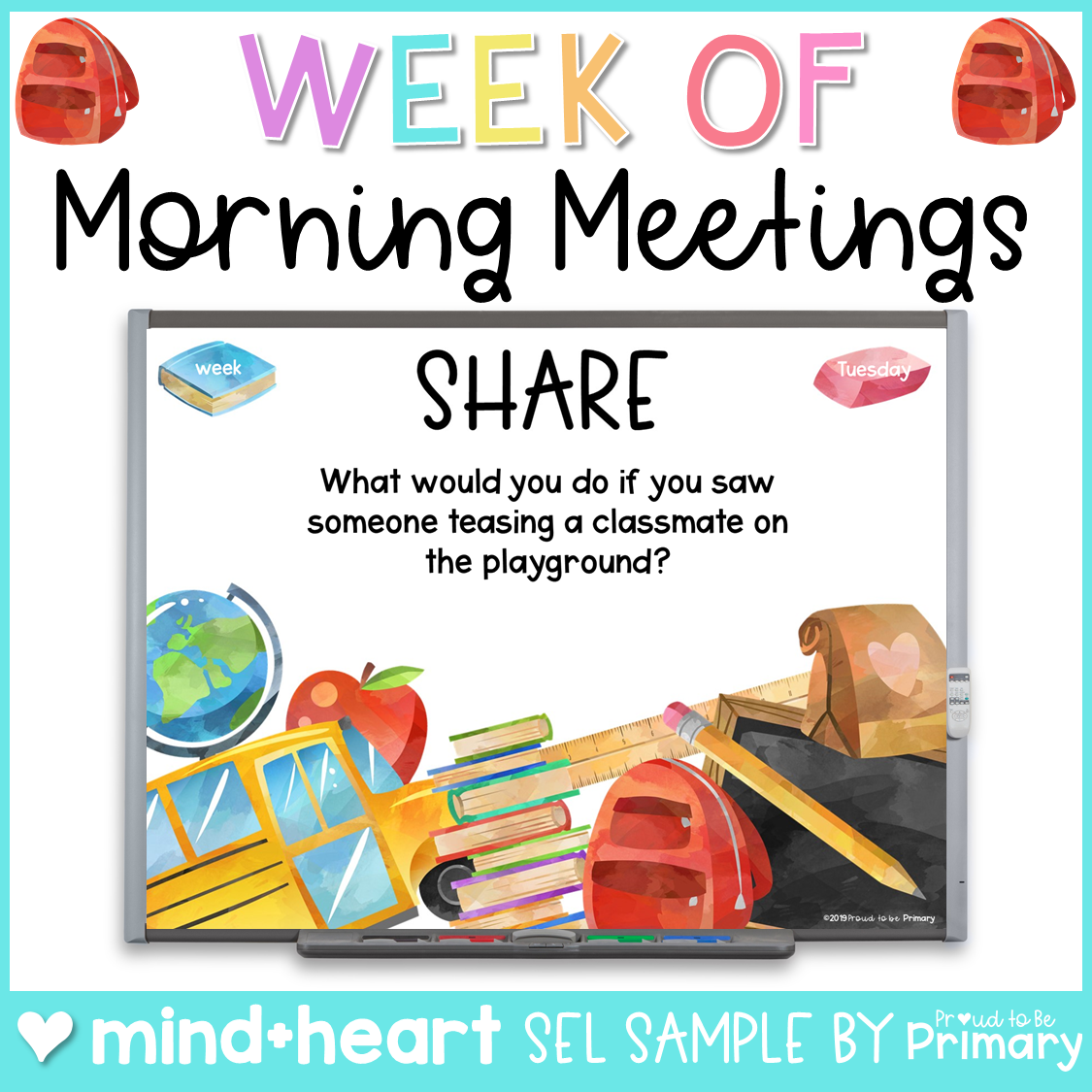
Free Week of Morning Meeting Materials
Want to start impactful morning meetings but don’t know where to start? Try a FREE week of Morning Meeting slides and cards. This done-for-you resource includes daily questions, greetings, and activities to engage kids in a meaningful morning meeting.
Click the image below to grab a copy.
Morning Meeting SEL Bundle
Try the Morning Meeting SEL Bundle by Proud to be Primary. It includes 11 months of morning meeting slides that your students will love. No more brainstorming what to do during the morning meeting; this bundle has everything prepped and ready.

More Morning Meeting Ideas & Activities


launching morning meeting first week
PIN for Later


