
This post may contain affiliate links, meaning I receive a small commission if you make a purchase using these links. As an Amazon Associate, I earn from qualifying purchases at no additional cost to you.
Time management for teachers: 10 time-saving tips that help any teacher get organized for the school year. Includes free checklists, labels, and more!

I’m here today to share some tried, tested, and true ways to save you time as a teacher. I have been teaching for many years, and in that time I have made many mistakes, but I have learned a lot about time management strategies for teachers.
My hope today is that you read my 10 time-saving tips for teachers and implement one or a few in your own classroom.
Time Management Tips to Help Teachers
We all know how precious our time is, especially at the beginning of the year when there is so much to do. We start one job and get distracted by another, often forgetting the first. This vicious cycle repeats, and by the end of the day we are exhausted and stressed. Sound familiar?
In this post, I will share some ways that I get my classroom ready before school starts and during back-to-school time. These things take time to prepare, but they will help your year get off to a great start and make your future years much easier!
Read on to learn my tips on time management for teachers, grab some freebies, and get organized!
Time Management for Teachers Tip #1: BEGINNING OF THE YEAR CHECKLIST
Create a checklist to take into your classroom during prep and setup. This is a huge pointer for effective time management for teachers.
I started typing out a beginning-of-the-year checklist a few years ago. I start the same list at the end of the school year and add to it throughout the summer.

Use an area on the checklist for class design & set-up, beginning-of-the-year activities and ideas, resources & books, bulletin boards, things to get ready, things to make (teacher DIY), things to photocopy, things to buy, and misc. things.
You can grab this template for FREE by clicking the image below.
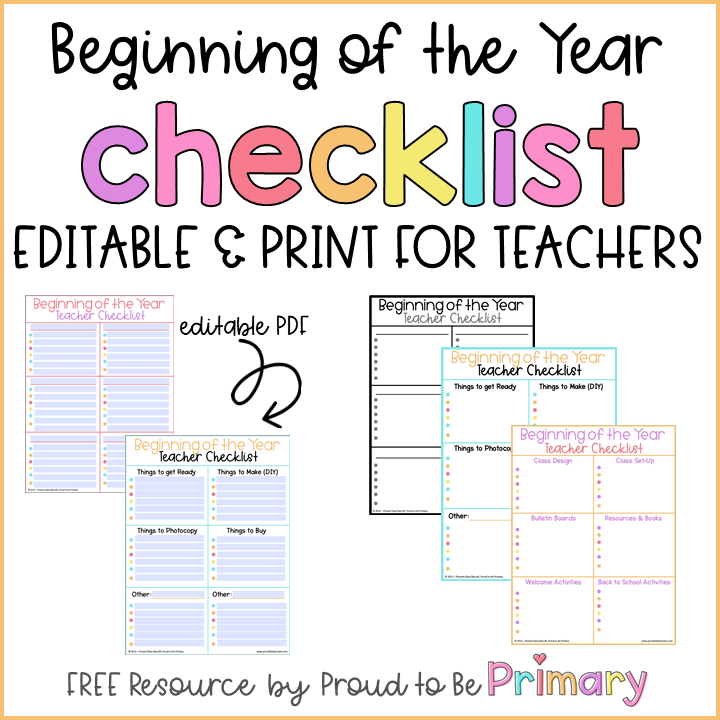
I print off the checklist and take this to school during classroom set-up. I prioritize the list, so I have a plan ahead of time for what to tackle first, second, and so on. As I finish tasks, I check them off. This gives me a sense of accomplishment at the end of each day. At the end of each day, I can look at my list and decide what to focus on the next day, and so on.
Time Management for Teachers Tip #2: PRINT LABELS WITH STUDENT NAMES
Make multiple copies of your students’ names ready to go on labels.
You will save a ton of time if you print your students’ names on labels ahead of time. You will not need to spend your time printing out your class list over and over again. If you label things in your classroom with your students’ names, you are ready to go.
Items you might label include workbooks, folders, binders, supplies, lockers or cubbies, mailboxes, book boxes…the list goes on.
I like to print my labels on the Avery shipping label sheets (#8165). They are a full page at 8 1/2″ by 11″, and you won’t need to format your labels perfectly to fit. This is especially helpful if you prefer larger labels or ones with different shapes (circles, fancy shapes, etc.). Then you can cut them out and stick them where you need them.
I also use the labels below, which are sized perfectly to fit Avery label #8163. I have made them EDITABLE, and they are FREE for you. You can grab them by clicking the image below!
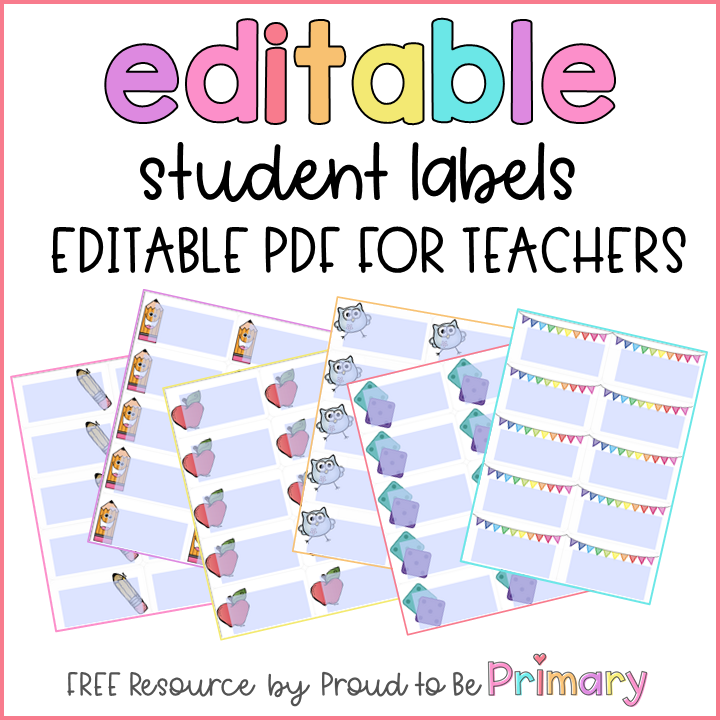
Raegan Tundall also has these awesome FREE labels, which are great for labeling all those books and folders. I suggest using EDITABLE supply labels so you can add your students’ names. Many cute options are available to dress up your students’ materials.
Time Management for Teachers Tip #3: ASSIGN STUDENTS A NUMBER
Provide each student with a number for the entire school year.
A few years back, I started assigning my students a number. This is a great classroom management and organization tip.
Once your students learn their number, you can use it to line them up in that order, call them to the carpet in that order, or call on students by number rather than name. I put their numbers on craft sticks and read out numbers on the carpet for turns. I have used craft sticks to make collaborative learning groups or pairs for P.E.
Student numbers are also great for labeling things in your classroom. You will only need to do this once, and it will be ready in future years.

I prefer to label student bookboxes, desks, and mailboxes with numbers. You can grab these FREE labels for your book boxes and get to labeling.

I have seen others use numbers on student work and work organization, assessments, pencils, clip charts, centers, and job charts.

The possibilities of things to label with student numbers are endless.
This saves supplies so you can reuse them, and it reduces prep time later.
Time Management for Teachers Tip #4: CLASS LISTS
Prepare class lists ahead of time. Keep them handy!
As soon as I get my list of student names, I make multiple copies and pin them to the bulletin board beside my desk. I use the lists constantly and attach them to completed work. They’re great for checking off student names as they return notices from home or money for events or field trips. I also include a few blank lists at the front of many of my teacher and assessment binders. This saves me time from searching for one, and it is handy when I need it.
The way I use class lists most is for assessment purposes. They are great for recording reading levels and scores, tracking completion of work and projects, or jotting down a note when we are at the carpet or in P.E. During math assessments, the top list shows the skills I am assessing, and I enter the information next to students’ names.
I use the basic list from the office for many things, but sometimes I need a different template with special or larger areas for notes. I create a list on my computer at the start of the year and add my students’ names. Keep a master copy at school and photocopy as needed.
Time Management for Teachers Tip #5: SYSTEM OF ORGANIZATION
Decide and set up an area for supplies, student work, and teacher materials. Have a place for everything!
While you set up your classroom, plan an area for supplies for small groups, math, whole-group activities, centers, etc. I usually place a tub of supplies at each location where I teach. Each tub has its own supplies for that instruction. Some materials stay in the tub the entire year, while others change daily, weekly, or monthly.
At my guided reading table, I have a tub with my lesson plans, assessment binder, games, sticky notes, whiteboard markers, reading comprehension checkers, and anything else I’m using. In my math instruction area, I have a tub with the math workshop schedule, lesson plans, manipulatives for the lesson, games, and math activities to complete.
This requires some preparation ahead of time and is ongoing, but it saves me from running around the room trying to find the supplies I need while my students wait.
Set up tubs with materials for each group pod. I include markers, pencils, and glue sticks.

There are also separate tubs of school supplies.

It is also important to have a system of organizing student materials when they are complete. My students hand in completed work into a bin, and from there I organize it. Some work goes into our WOW work bin that I have organized with names. I place special work samples in this bin, and later I put them into student portfolios that we use during student-led conferences.
These portfolios are also great keepsakes for students. Families appreciate these and love seeing the growth. To read more about how I set up my student portfolios and grab some FREEBIES to set up your own portfolios.

I teach my students early in the school year about my organization system so they know how it works.
We use classroom management in my room to help keep things organized. There is a job for librarian (helps keep books organized and returns books to the library), clean-up helper (helps put materials away into the right spots), messenger (helps put the mail into the mailboxes), paper monitor (helps collect paper and put them into our work bins), and more. These classroom jobs help manage so much!

Time Management for Teachers Tip #6: CLASSROOM MANAGEMENT
Have a few strategies ready to teach your students at the beginning of the year.
It is important to have a plan for the day of school. Decide ahead of time what strategies you will use and research those methods. Get your materials ready and make a plan for how you will teach your students and what you will say.
If you make these decisions ahead of time and take the time to teach them at the start of the year, it will save you a ton of time throughout the year. When students understand the classroom expectations right from the start, there will be fewer disruptions from negative behaviors. For example, review your classroom rules and post them. In return, students understand expectations. They will usually follow those rules.
Read my 10 Classroom Management Tips and Tricks. You can grab some FREE management tools and great suggestions there.

Time Management for Teachers Tip #7: DAILY, WEEKLY, MONTHLY TO-DO LISTS
Prepare daily, weekly, and monthly task lists. Have it in a highly visible place!
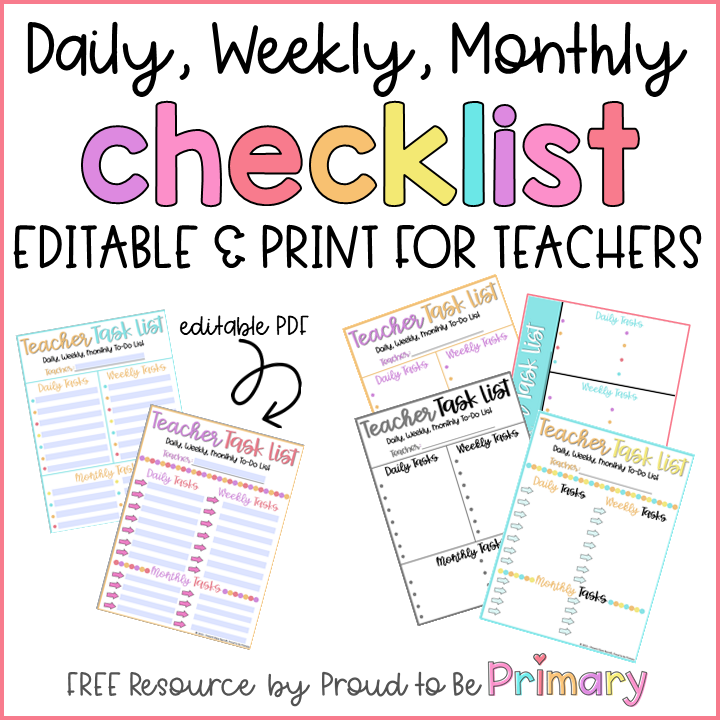
I like to have a to-do list attached to my desk, next to my calendar. On my to-do list, I have a section for daily taskssections tasks, anly tasks. You could laminate a copy so you can check it off and mark it. You could post it on your teacher bulletin board. Find a way that works for you!
The daily to-do list might include
- check student work
- stack chairs
- sharpen pencils
- hand-out morning work
- hand out work
Include these items on your weekly to-do list
- washboards
- lesson planning
- photocopying
- prep materials
- meet with ____
On your monthly to-do list, you might include
- change out books on the bookshelf
- unit planning
- plan assessments
- monthly newsletter
If you would like a copy of my to-do list template to create your own, click the image below.
Time Management for Teachers Tip #8: PREPARE IN ADVANCE
Pick one day of the week to get things ready for the following week. Stick to it!
Since the beginning of my career, I’ve found it is better to know, prepare, and plan my lessons well in advance rather than the day before. You never know what may happen that might take you away from your prep time. You might get sick or need to be away from school unexpectedly.
Once I start my lessons and get ready the week before, things are easier and less stressful, and I feel great walking into your class in the morning with most of the day prepared. Of course, there are always things to do each day, but having the intention to plan is a plus!
I suggest picking one day in the middle of the week so that you don’t have too many other commitments. Spend extra time that day before or after school preparing your materials for the following week. Sit down and write your lesson plans or day plan in advance. From there, photocopy, cut, glue, or whatever you have to do.
Time Management for Teachers Tip #9: WORK & ACTIVITIES FOR EARLY FINISHERS
Prepare extra work, review activities, and educational games for fast finishers. Keep them busy!
I have a ring of fast-finisher activities posted on our pocket chart, ready for students who finish an activity before others. I teach them that they can start one of these activities independently. These activities do not require extra teaching time from me and can happen without disrupting the class.
Disrupting activities include puzzles, whiteboards, books, and math manipulatives. Students who love to get ahead choose to finish work from the “to be completed” bin. Some also love to get ahead in math or language arts. I will copy extra activities for them and have them ready in a hang-keep folder they can access.

Class Fast Finisher cards help students transition from activity to activity and keep them busy when the teacher is working with other students; the activities are simple to prep and are often ones students complete every day. They are the perfect busy work that will keep students focused on learning while the rest of the class is completing work.
Time Management for Teachers Tip #10: MAKE AND SAVE SAMPLES
Take the time to make great work samples the first time. Save them!
I quickly tire of not saving what I make and having to redo the same samples year after year. Instead, I started creating quality samples and saving them in my files for future years. I create samples for anchor charts, arts and crafts samples, completed printable worksheets, math games, and more.
Spend time before a lesson creating samples and anchor charts that you would want to save. Save all of your samples with your lesson plans and materials for a given unit. Your samples will come in handy in future years when you are teaching lessons, and you have something prepared to share with your students. Yes, it takes time when you start this, but it saves you time in the future.
I hope that you have gained some new time-saving tips to make your year run smoothly from my 10 time-saving tips for teachers. My wish is that you get more time to focus on your student’s needs and their learning. Good luck!
More Classroom Management Tips for Teachers


Tips for New Teachers: What I Wish I Knew.

Classroom Organization Ideas You Won’t Believe You Did Without
PIN for Later


